Well, we get colds anyway. I was hoping to paddle last weekend - a long weekend due to Martine Luther King Jr Day - but I developed a sore throat that got worse and worse, to the point where I went to the doctor and got some antibiotics. I'm afraid that strands me on land this weekend too. I'm on the mend and don't want to wreck it.
Meanwhile, planning continues for the coming summer. There will be some good weekends for paddling out to Sandy Hook, and maybe Jamaica Bay. I'm also looking at some teaching assistant opportunities, and looking to level up some of my certifications. Gotta work on that roll! So while I'm not physically on the water, I'm there in spirit.
Thursday, January 24, 2013

Sunday, January 13, 2013
Foggy Paddle
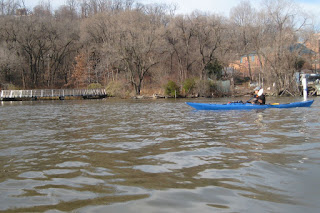
On Saturday I paddled north out of Inwood from Inwood Canoe Club with my friend MH. While the air and water temperatures were relatively mile, the sky was overcast and a fog bank approached from the north. We started later than expected, paddling against the current most of the way to a point just past the Riverdale station for Metro North, before turning around and gliding back home.
MH is a canoe guy, with a fantastically light solo canoe, faster and just as nimble as me in a sea kayak. I paddled a Wilderness Systems Tempest 170, one of the club boats, since my own is still locked up in a boathouse that is more or less inaccessible.
While the current was strong and only got stronger as we paddled, it was smooth as glass. We kept close to the shore and worked our way up. This was the first time I paddled north of Manhattan on the eastern side of the Hudson. There are some very nice houses, as well as the relics of old railroad structures no longer in use, such as a foot bridge, missing its floor, that descends to the waterline several yards past the shore. We passed the Riverdale Yacht Club, the Metro North Station, and were just short of the sewer treatment plant for the city of Yonkers when we decided to turn around.
One interesting part of the trip was paddling past Spuyten Duyvil. This is the area, known to be somewhat treacherous, where the Harlem river connects with the Hudson at a perpendicular angle, creating weird current effects. Normally I am paddling into the Harlem, and I'm familiar with managing these strange effects. However, this time I was paddling past it, as current flowed out of the Harlem toward me as the Hudson flowed towards me head-on; the result was dozens of little vortices, baby versions of tall-tale terrors, an S-shaped eddy lines formed by cross currents pushing me this way and then that, which would have spun my boat like a top if I didn't manage steering with some strong sweep strokes. I was also gradually move out further into the river, meaning I had more current against me, and it was a fair amount of work to not only stay straight, but to angle back in towards shore, where we could continue on our way.
I did not bring my camera along, and while I wish that I had, I'm not sure that it would have captured the sublime beauty of this trip. It was quiet, for one thing, and there was no other traffic while we paddled - no ships, no barges, no small craft. Our voyage was only punctuated by a train going by periodically along the Hudson Line tracks.
Across the way, we could see the Palisades, but even these disappeared gradually as we met the fog bank. When we left, the air was clear but we could see the fog far up the river. It rolled down as we paddled, so that by the time we were in Riverdale, we could see it curling past the Palisades, encroaching upon houses, and enshrouding our view as we crept northwards.From Riverdale Station, we could barely make out the towers of the George Washington Bridge.
Coming back was a breeze. While I tend to paddle even with current, it was nice to not have to work so hard to keep moving forward, and I was able to take in the view that we had paddled past. I paddled farther out into the river and saw both sides, now with more fog obscuring their features, but with a glassy-smooth water surface that doubled everything before me. MH kept closer to shore, leaving me mostly alone to take it all in - the quiet, the cliffs, the expense of cloudy nothingness before me slowly resolving to familiar landmarks. There was the Henry Hudson Bridge, and there was the George Washington Bridge (named, I should point out, for men who crossed these waters under considerably greater duress). There were the Cloisters, peeking above the elevated treeline of Fort Tryon Park, and there was the marina and Englewood Cliffs.
We came in and climbed out, hauling our boats and then cleaning them. We stayed to do some work around the boathouse - still being improved following post-Sandy repairs, and then that was that - the end of a beautiful day on the water - in January.
I will end by saying that temperatures are unusually warm for winter. It's January and the air was in the high forties, predicted tobe in the low fifties in some parts of the city. Water temperatures have dropped to the high forties and are more of a concern from the perspective of judging paddling risk. While it certainly isn't summer paddling, it's not quite ice paddling either. We'll have to see if this turns out to be a cold inaugural winter paddling season for me.
MH is a canoe guy, with a fantastically light solo canoe, faster and just as nimble as me in a sea kayak. I paddled a Wilderness Systems Tempest 170, one of the club boats, since my own is still locked up in a boathouse that is more or less inaccessible.
While the current was strong and only got stronger as we paddled, it was smooth as glass. We kept close to the shore and worked our way up. This was the first time I paddled north of Manhattan on the eastern side of the Hudson. There are some very nice houses, as well as the relics of old railroad structures no longer in use, such as a foot bridge, missing its floor, that descends to the waterline several yards past the shore. We passed the Riverdale Yacht Club, the Metro North Station, and were just short of the sewer treatment plant for the city of Yonkers when we decided to turn around.
One interesting part of the trip was paddling past Spuyten Duyvil. This is the area, known to be somewhat treacherous, where the Harlem river connects with the Hudson at a perpendicular angle, creating weird current effects. Normally I am paddling into the Harlem, and I'm familiar with managing these strange effects. However, this time I was paddling past it, as current flowed out of the Harlem toward me as the Hudson flowed towards me head-on; the result was dozens of little vortices, baby versions of tall-tale terrors, an S-shaped eddy lines formed by cross currents pushing me this way and then that, which would have spun my boat like a top if I didn't manage steering with some strong sweep strokes. I was also gradually move out further into the river, meaning I had more current against me, and it was a fair amount of work to not only stay straight, but to angle back in towards shore, where we could continue on our way.
I did not bring my camera along, and while I wish that I had, I'm not sure that it would have captured the sublime beauty of this trip. It was quiet, for one thing, and there was no other traffic while we paddled - no ships, no barges, no small craft. Our voyage was only punctuated by a train going by periodically along the Hudson Line tracks.
Across the way, we could see the Palisades, but even these disappeared gradually as we met the fog bank. When we left, the air was clear but we could see the fog far up the river. It rolled down as we paddled, so that by the time we were in Riverdale, we could see it curling past the Palisades, encroaching upon houses, and enshrouding our view as we crept northwards.From Riverdale Station, we could barely make out the towers of the George Washington Bridge.
Coming back was a breeze. While I tend to paddle even with current, it was nice to not have to work so hard to keep moving forward, and I was able to take in the view that we had paddled past. I paddled farther out into the river and saw both sides, now with more fog obscuring their features, but with a glassy-smooth water surface that doubled everything before me. MH kept closer to shore, leaving me mostly alone to take it all in - the quiet, the cliffs, the expense of cloudy nothingness before me slowly resolving to familiar landmarks. There was the Henry Hudson Bridge, and there was the George Washington Bridge (named, I should point out, for men who crossed these waters under considerably greater duress). There were the Cloisters, peeking above the elevated treeline of Fort Tryon Park, and there was the marina and Englewood Cliffs.
We came in and climbed out, hauling our boats and then cleaning them. We stayed to do some work around the boathouse - still being improved following post-Sandy repairs, and then that was that - the end of a beautiful day on the water - in January.
I will end by saying that temperatures are unusually warm for winter. It's January and the air was in the high forties, predicted tobe in the low fifties in some parts of the city. Water temperatures have dropped to the high forties and are more of a concern from the perspective of judging paddling risk. While it certainly isn't summer paddling, it's not quite ice paddling either. We'll have to see if this turns out to be a cold inaugural winter paddling season for me.
Sunday, December 16, 2012
December Paddling
It's a sign of my non-kayaking life that I haven't blogged about last week's paddle, and so I'll describe it briefly before diving into yesterday's. In both cases, these have been my first drysuit paddles. While the air temperature hasn't been too terrible, the water temperature has officially fallen below 50 degrees fahrenheit, making the protection of a drysuit a necessity.
Last weekend - the 8th - I went to the Inwood Canoe Club intending to work on a boat I've been repairing, and then to go for a paddle. As it happened, I ran in to one of the club officers, KM, who was heading out for a paddle. I reversed my plans, paddling with him before coming back to work on the boat.
The current was near max ebb as we headed north, making for a hard paddle up the river. Wind was coming from the west, so as we made the turn to go into Spuyten Duyvil, there were some squirrelly currents to deal with. Once we were in the Harlem River, however, both the wind and current died down a bit, and we had an easier time. We made it as far as the Broadway Bridge before turning around and heading back - much easier as drifted back with the current.
Yesterday, I went out with AA, another friend from the club. We timed our trip with the current, riding up the Hudson quickly and into the Harlem.
As we came up by Peter Sharp, we too in the coastline. Accustomed to spring and summer, the most noticeable difference is that with a lack of foliage, much more is visible.
We decided to keep on, heading for the three bridges of Hamilton, Washington, and High Bridge. As we approached, the current abruptly changed, and we only made it to the first of these bridges before deciding to turn back.

Earlier, we realized we had not seen anyone else on the water - including motorized vessels. That changed as one of the Classic Harbor Line vessels (the Manhattan) approached and passed us by.

We paddled back and landed at the near near Peter Sharp, aka Swindler's Cove. We took an extended break, used the local facilities, took pictures, talked about things going on in the club. We watched the tide drain out, leaving our boats high and dry. We hoped in and paddled around, stopping in a nearby marsh area first.
I like to chase wildlife. Geese are pretty patient; Mallards will take flight at a greater distance. Whatever these birds were, they allowed me to tail them, riding in their wake.

Generally, conditions in both the Harlem and the Hudson were very calm. With slow current, the water became glass-like, lending itself to plenty of reflective images such as this.

As we went back, I snapped this shot of the Spuyten Duyvil railroad bridge. We watched it move from closed to open, to closed again, locking into place with a distinctive sound.

And that was our trip. The current had tuned while we were out, making for a much easier trip on the way back.
I'll write in more detail about the drysuit separately, but generally, it works really well - though I haven't put it through trials yet. I do tend to retain a lot of heat, and need to adjust my layering underneath, and I'm still perfecting my acrobatic routine for donning and exiting the suit. However, it isn't hard to paddle in, and I'm looking forward to more paddling further into the winter season.
Last weekend - the 8th - I went to the Inwood Canoe Club intending to work on a boat I've been repairing, and then to go for a paddle. As it happened, I ran in to one of the club officers, KM, who was heading out for a paddle. I reversed my plans, paddling with him before coming back to work on the boat.
The current was near max ebb as we headed north, making for a hard paddle up the river. Wind was coming from the west, so as we made the turn to go into Spuyten Duyvil, there were some squirrelly currents to deal with. Once we were in the Harlem River, however, both the wind and current died down a bit, and we had an easier time. We made it as far as the Broadway Bridge before turning around and heading back - much easier as drifted back with the current.
Yesterday, I went out with AA, another friend from the club. We timed our trip with the current, riding up the Hudson quickly and into the Harlem.
As we came up by Peter Sharp, we too in the coastline. Accustomed to spring and summer, the most noticeable difference is that with a lack of foliage, much more is visible.

Paddling Past the Park.
We decided to keep on, heading for the three bridges of Hamilton, Washington, and High Bridge. As we approached, the current abruptly changed, and we only made it to the first of these bridges before deciding to turn back.

The Hamilton, Washington, and High bridges.
Earlier, we realized we had not seen anyone else on the water - including motorized vessels. That changed as one of the Classic Harbor Line vessels (the Manhattan) approached and passed us by.

The commercial touring yacht Manhattan.
We paddled back and landed at the near near Peter Sharp, aka Swindler's Cove. We took an extended break, used the local facilities, took pictures, talked about things going on in the club. We watched the tide drain out, leaving our boats high and dry. We hoped in and paddled around, stopping in a nearby marsh area first.
I like to chase wildlife. Geese are pretty patient; Mallards will take flight at a greater distance. Whatever these birds were, they allowed me to tail them, riding in their wake.

Birds on the Water, Harlem River, New York.
Generally, conditions in both the Harlem and the Hudson were very calm. With slow current, the water became glass-like, lending itself to plenty of reflective images such as this.

Bronx Buildings Reflected
As we went back, I snapped this shot of the Spuyten Duyvil railroad bridge. We watched it move from closed to open, to closed again, locking into place with a distinctive sound.

And that was our trip. The current had tuned while we were out, making for a much easier trip on the way back.
I'll write in more detail about the drysuit separately, but generally, it works really well - though I haven't put it through trials yet. I do tend to retain a lot of heat, and need to adjust my layering underneath, and I'm still perfecting my acrobatic routine for donning and exiting the suit. However, it isn't hard to paddle in, and I'm looking forward to more paddling further into the winter season.
Saturday, November 24, 2012
Thanksgiving Paddle
I went paddling with a friend on the Friday after Thanksgiving. The air temperature was predicted to be relatively warm, in the low fifties, and the rest of the forecast was otherwise acceptable. AW and I met at the Inwood Canoe Club, and went out for a couple of hours, heading south against the current and crossing the river, before heading back with the flood tide.

Details for the more technically inclined: because the water temperature is dropping, AW wore her drysuit over layers. I wore a wetsuit with a Kokotat Tropos jacket and waterproof pants, along with some new Kokotat water boots. Unlike scuba diving shoes, the sole is hard, making them better for bracing against foot pegs.
Since the Argonaut (my boat) is rapped at the still-closed Pier 96, I paddled a club Looksha IV. I have most of my gear, including my sprayskirt, so it wasn't too different from how I usually paddle. The main difference is that the Looksha has a rudder system rather than a skeg, as my boat does. I would be missing that skeg later in the trip. AW paddled her Tiderace Xplore-S.
While we got ready, we saw another paddler in a short boat making his way down and across the river. We caught up with him later. His name was Dan Barron, paddling a surf kayak. He had launched at the beach at Dyckman, just north of us, and was on his way back when we caught up with him just north of Riverbank State Park.
AW headed down on the Manhattan side, with no particular destination in mind. The current was already flooding in, and would hit max flood about two hours after we left, so the current was increasingly against us as we went. We figured we would get as far as 125th street, and maybe cross the river earlier. Since we felt like we were doing well, we crossed below the George Washington Bridge, and then made our way south. We made it as far as the Ferryboat Binghamton, but not to our reach destination of Mitsuwa. While not much further, if we had gone there, we would have have simply turned right around in order to cross the river before it got too dark to be safe. We only had one light between us and didn't want to risk crossing without more lights.

Traffic was on the light side. We only saw a couple of motor boats, and only one barge, much farther down the river than we were going. There was a DEP boat at Riverbank, which slipped its mooring and headed south while we were resting across the river. There was a NY Waterways ferry coming and going from Edgewater; we saw it a couple of times. Otherwise, however, traffic was very quiet, and we were able to enjoy the scenery.
The foliage along the river really was hitting its autumnal bloom. There were gorgeous red anr orange leaves, many falling into the river. We took in some of the new construction along the bike path being created south of the boathouse, and spotted some new ramshackle fishing holes - bespoke wooden shanties along the river that locals fish from. We saw some guys fishing, and we also saw what looked like a volunteer trash cleanup on the rocks just north of the Manhattan tower on the GWB. We also saw some new decorative detritus - a guitar panel hanging from a tree, and a speed limit sign resting on a rock, facing out on the river. This was a land-based sign, mind you, advising speeds no faster than forty miles per hour.
Not too long after we left, I spotted a bottle floating in the water. I paddled close to look at it, becase it looked unusual. I was a wine bottle than someone had turned into a 'message in a bottle', complete with phone number to call. I kept it with me to look at when we got back.
As we paddled, the wind picked up, and after crossing the river, it tended to cock my boat to the left. I did a lot of sweep strokes to the left as we made our way down. On the way back, after crossing the river, the wind changed direction, and tended to cock my boat towards the right, towards Manhattan, when I wanted to go north. The wind didn't feel strong, but the apparent motion of the river was east too west, rather than north, as the current was flowing. It was frustrating, but by taking a couple of breaks, I managed to keep the boat headed in the right direction despite the wind.
When we got back, we tried opening the bottle, but it the message was wet inside. I took it home and, after washing the bottle, let it dry with my other gear, eventually using a hair dryer to dry the message out. It came out in two pieces, which, once put back together, spelled out a message of: Thanksgiving 2K12.
I've been considering a drysuit lately, and this paddle certainly makes me want to continue paddling through the winter - for self-maintenance if nothing else. I was surprised at how out of shape I felt after just a month of not paddling. I want to continue paddling in order to keep my skills up, as well as to stay in good physical shape. I have a lot of paddling planned for next summer, and I can't be starting over physically in May.

Looking South at the GWB
Details for the more technically inclined: because the water temperature is dropping, AW wore her drysuit over layers. I wore a wetsuit with a Kokotat Tropos jacket and waterproof pants, along with some new Kokotat water boots. Unlike scuba diving shoes, the sole is hard, making them better for bracing against foot pegs.
Since the Argonaut (my boat) is rapped at the still-closed Pier 96, I paddled a club Looksha IV. I have most of my gear, including my sprayskirt, so it wasn't too different from how I usually paddle. The main difference is that the Looksha has a rudder system rather than a skeg, as my boat does. I would be missing that skeg later in the trip. AW paddled her Tiderace Xplore-S.
While we got ready, we saw another paddler in a short boat making his way down and across the river. We caught up with him later. His name was Dan Barron, paddling a surf kayak. He had launched at the beach at Dyckman, just north of us, and was on his way back when we caught up with him just north of Riverbank State Park.
AW headed down on the Manhattan side, with no particular destination in mind. The current was already flooding in, and would hit max flood about two hours after we left, so the current was increasingly against us as we went. We figured we would get as far as 125th street, and maybe cross the river earlier. Since we felt like we were doing well, we crossed below the George Washington Bridge, and then made our way south. We made it as far as the Ferryboat Binghamton, but not to our reach destination of Mitsuwa. While not much further, if we had gone there, we would have have simply turned right around in order to cross the river before it got too dark to be safe. We only had one light between us and didn't want to risk crossing without more lights.

The Ferryboat Binghamton, November 2012
Traffic was on the light side. We only saw a couple of motor boats, and only one barge, much farther down the river than we were going. There was a DEP boat at Riverbank, which slipped its mooring and headed south while we were resting across the river. There was a NY Waterways ferry coming and going from Edgewater; we saw it a couple of times. Otherwise, however, traffic was very quiet, and we were able to enjoy the scenery.
The foliage along the river really was hitting its autumnal bloom. There were gorgeous red anr orange leaves, many falling into the river. We took in some of the new construction along the bike path being created south of the boathouse, and spotted some new ramshackle fishing holes - bespoke wooden shanties along the river that locals fish from. We saw some guys fishing, and we also saw what looked like a volunteer trash cleanup on the rocks just north of the Manhattan tower on the GWB. We also saw some new decorative detritus - a guitar panel hanging from a tree, and a speed limit sign resting on a rock, facing out on the river. This was a land-based sign, mind you, advising speeds no faster than forty miles per hour.
Not too long after we left, I spotted a bottle floating in the water. I paddled close to look at it, becase it looked unusual. I was a wine bottle than someone had turned into a 'message in a bottle', complete with phone number to call. I kept it with me to look at when we got back.
As we paddled, the wind picked up, and after crossing the river, it tended to cock my boat to the left. I did a lot of sweep strokes to the left as we made our way down. On the way back, after crossing the river, the wind changed direction, and tended to cock my boat towards the right, towards Manhattan, when I wanted to go north. The wind didn't feel strong, but the apparent motion of the river was east too west, rather than north, as the current was flowing. It was frustrating, but by taking a couple of breaks, I managed to keep the boat headed in the right direction despite the wind.
When we got back, we tried opening the bottle, but it the message was wet inside. I took it home and, after washing the bottle, let it dry with my other gear, eventually using a hair dryer to dry the message out. It came out in two pieces, which, once put back together, spelled out a message of: Thanksgiving 2K12.
I've been considering a drysuit lately, and this paddle certainly makes me want to continue paddling through the winter - for self-maintenance if nothing else. I was surprised at how out of shape I felt after just a month of not paddling. I want to continue paddling in order to keep my skills up, as well as to stay in good physical shape. I have a lot of paddling planned for next summer, and I can't be starting over physically in May.
Thursday, November 8, 2012
Sandy
A hurricane - wait, it wasn't, it was a large storm - whatever it was, Sandy hit New York City last week. More accurately, it made landfall on the eastern seaboard, devastating beach communities in New Jersey, Staten Island, and Long Island. Power was knocked out for millions in the region, and massive flooding drowned lower Manhattan to a level where some buildings won't be usable for weeks.
Relevant to this blog, the flooding came up very high at both of the boathouses I paddle out of. At Pier 96, the water came into the boathouse to about four feet high, depositing a thin layer of mud on the concrete floor. At Inwood Canoe Club, the water came up higher because the boathouse sits lower. The flooding lifted the launch dock higher than the main dock, and swept away portions of the retaining wall that holds dirt onto the island.
In both cases, the clubs had taken measures to lift everything up high that had to be and could be. Paddles, floats, papers, electronics - everything went up or went away. fiberglass boats were lifted to at least four feet off the ground. I'm happy to say the Argonaut, ten feet up and as high as could be, survived without incident. the only damage, such as it was, was mostly cosmetic to the boathouses. In the case of Pier 96, the Hudson River Park Trust is tackling the major repairs, and at Inwood, the club is putting together a plan to replace lost soil, repair the walls, and clean the place up.
In both cases, work days after the storm cleared away the detritus that washed in, and through out the wreckage of what was left. The boathouses are in good shape, though there is still work to be done at each.
This is all a long way of saying I haven't been out on the water recently. There is a possibility of getting out this weekend, but following the storm, there was a sudden drop in temperature, and as the weeks roll by, we'll soon be in drysuit-only season.
But fear not! The cowgirl has prepared for this contingency, and if she's not out paddling, she'll be blogging, and writing down kayak-related thoughts that she hasn't had time for in the regular paddling season.
Relevant to this blog, the flooding came up very high at both of the boathouses I paddle out of. At Pier 96, the water came into the boathouse to about four feet high, depositing a thin layer of mud on the concrete floor. At Inwood Canoe Club, the water came up higher because the boathouse sits lower. The flooding lifted the launch dock higher than the main dock, and swept away portions of the retaining wall that holds dirt onto the island.
In both cases, the clubs had taken measures to lift everything up high that had to be and could be. Paddles, floats, papers, electronics - everything went up or went away. fiberglass boats were lifted to at least four feet off the ground. I'm happy to say the Argonaut, ten feet up and as high as could be, survived without incident. the only damage, such as it was, was mostly cosmetic to the boathouses. In the case of Pier 96, the Hudson River Park Trust is tackling the major repairs, and at Inwood, the club is putting together a plan to replace lost soil, repair the walls, and clean the place up.
In both cases, work days after the storm cleared away the detritus that washed in, and through out the wreckage of what was left. The boathouses are in good shape, though there is still work to be done at each.
This is all a long way of saying I haven't been out on the water recently. There is a possibility of getting out this weekend, but following the storm, there was a sudden drop in temperature, and as the weeks roll by, we'll soon be in drysuit-only season.
But fear not! The cowgirl has prepared for this contingency, and if she's not out paddling, she'll be blogging, and writing down kayak-related thoughts that she hasn't had time for in the regular paddling season.
Sunday, October 28, 2012
Peter Sharp Group Paddle
I had an idea to paddle to Peter Sharp again, or at least to points north. We're also at the end of the season, not long before the combination of water and air temperature drops below the threshold for more specialized protective gear. I've already been paddling with my paddling jacket lately, and planned to start using my wetsuit soon. So, I thought it might be a good idea to invite some other people along, just to make sure I'm not out all by my lonesome, just in case something bad happens.


After sending out a group invite, I had two takers: MA and DS, both experienced paddlers. These ladies are getting up in their years but they are strong, and can paddle long. They'd be great companions.
I ought to mention that this was just a couple of days before a tropical storm was to hit New York City, or at least the eastern seaboard. TS Sandy, aka the "frankenstorm" was floating somewhere off the coast of Georgia, so we figured this would be the last day we could safely paddle before the storm hit.
We set off early, around 820, to catch as much tide as we could. The skies were gray and cloudy, but temperatures were not bad - about 60 F for both air and water. We passed some barges parked in the river - as well as one moving south, unusually, on the Manhattan side. There is a large charted shipping channel on the New Jersey side of the river. I don't really ever seeing a barge that big, that far north, on the east side of the river. We paddled further out into the middle of the river to pass it on our left.
By now, this route is familiar, old hat, dare I say routine, keeping in mind that no day on the water is ever routine (see above paragraph about the barge). However, the paddle north was pretty straightforward: we passed Fairway, Riverbank State Park, Inwood Canoe Club, and passed under the railroad bridge to take a short break in a cove at Spuyten Duyvil.

I tried getting close to a flock of geese in the water.

At this point, the current picked up against us. Water was flowing out of the Harlem and into the Hudson. While it wasn't bad at first, it did become progressively harder, and as we slowed down, we tucked in to the shore, where the current is less strong.
We passed some crew boats, presumably from Columbia University. Later, near Peter Sharp, we spotte some people on the Bronx side of the river dismantling their dock. It was the Harlem River Rowing Club, a non-profit focused on rowing, based out of (I believe) Roberto Clemente Park. They were dismantling their dock in anticipation of TS Sandy.

We landed at Swindler's Cove - a small beach that is part of the park near Peter Sharp. Peter Sharp was in use, and in any case, the bathrooms are in the park - although this day we would learn that they were out of order, leading us to use some more dismal portable facilities about a five minute walk away.

Some volunteers were weeding and rep-planting. We sat at a picnic table and ate our lunch. I had one of my civilian MREs - Creamy Chicken Tetrazini, which was actually quite good.
Because we'd run into current coming in, our stay was foreshortened, and we left about an hour after we landed. Now, we had the current with us, not only in the Harlem but on the way back. We were passing under the George Washington Bridge just before maximum ebb. To give you an idea of the difference this made, it took us three hours and fifteen minutes to get to Peter Sharp, but only about two hours to get back.

One the way back, we stopped to take pictures in front of the autumnal foliage. Between the Palisades on one side, and Washington Park on the other, there were ample instances of yellow, red, and even green leaves, against a somber gray sky, with just enough sunlight to bring out the colors.

We also stopped briefly at Inwood to say hi to some of my friends there, who were working on the dock, upgrading the flotation. They warned me not to linger, lest I get pressed into service.
As we rocketed back, I realized we were going to want o get in close to the shore well before we got to Pier 96, or else the current would carry us past it. As it was, we ended up making a sort of ferry crossing in - paddling straight at the shore while the current carried us down. Along the way, we saw a fish jump out of the water - a big one two, about 15 inches long as far as we could tell. He made it a good foot or so out of the water, and I scared one of my co-workers, because I yelped "fish!" right as I was turning to check on our other paddle-mate. I wish I'd gotten a picture, but fish are pretty unpredictable.
This was a good trip - a nice distance, a bit of a challenge on the current, and for some, possibly the last paddle of the season. While it's a familiar trip by now, it is by no means routine. It's definitely one I'll keep in my back pocket as a sort of extended trip to invite others on.
Piermont
I'm falling behind in my paddle blogging. I actually have two trips to tell ya'll about. My trip two weeks ago to Piermont is where I'll start.
Piermont is a small township in New York, just south of Nyack. Below it, on the south side of a lengthy pier, is a salt marsh, full of reeds, critters, and tall reeds. Some of my Inwood friends have been up there a few times, and suggested it as a trip. Along with me were IL, AW, AA, BG, and LL. MH met us later in the day in his canoe.
The most notable thing about paddling up there, and later back down, was the wind. It was steady and mostly from the south, occasionally coming from the east. From the south was OK, but from the east, it would cock our boats when it picked up. While not dangerous, it meat that paddling up was some work, and for one of our less experienced paddlers, a hard introduction to the value of a sweep stroke.

Once we arrived at the marsh, however, things were much calmer. The wind died down, for one thing, and once we were in the marsh, we were sheltered enough that there was pretty much no wind. There are a couple of canals that wind their way through the marsh, allowing us to penetrate pretty deeply, until the weeds narrowed or the water got too shallow - or in one case, a large treefall blocked out path. We maneuvered under branches, around logs, and pushed over mud flats for an hour or so, before heading south for lunch.

We stopped at a place called "Italian Garden". It's a little beach a couple of miles south of the marsh, part of a hiking trail near Alpine. Wed been there before, on a hiking trip in winter. Now we were landing there in our boats. We had lunch, rested, and waited for the tide to pick up. MH paddled up in his canoe, and by pure coincidence we met someone involved in the community-based testing of water quality, who knew some of the Inwood people from their participation in the program.

Eventually, it was time to leave and we set out, with the current but with the wind in our face, giving us some fun waves to play in.
I ought to mention that we also saw the results of a recent rockslide, north of Alpine but below Italian Garden. It occurred last spring, and it's clear from the color of the rock where it happened.

As we passed the marina at Alpine, we spotted the sloop Clearwater, the flagship of Riverkeeper, a non-profit organization devoted to environmental concerns on New York waterways. I actually paddled out to say hello - and get an indication of their intentions, because for a while it looked like they were going to make a U-turn and arc into our path. They weren't - they were heading to Alpine - which made it odd that the next day, we read that they'd run aground in the low tide.
As we came back, we saw familiar landmarks - the Henry Hudson bridge, the George Washington bridge, the New York City skyline in the distance. This was a great trip, one that, like our Bronx Kill trip, took me to an environment totally unlike the big-river paddling I normally do. If you' in the area, the Piermont marsh is a great stop on any itinerary.
Subscribe to:
Posts (Atom)