I bought a drysuit this year. Not only did I buy a drysuit, but I bought a pretty high-end one. I got a good deal on it, as it was an older model, and also had some cosmetic blemishes that brought the price down close to the high end of my budget. I bought it not only because I wanted to paddle in winter, but to comfortably extend the ends of the paddling season into periods when the water would be cold despite reasonable air temperatures.
W hile there are many manufacturers, most have a light layer and a heavy layer of materials to choose from; in my case, I went with the heavy-layer Kokotat Gore-Tex Expedition WFR (Women's with Front Relief). It's essentially a (wo)man-shaped Gore-Tex bag with latex gaskets at the wrist and neck, and a heavy zipper running diagonally from the right shoulder the left waist. "These zippers are the same kind they use in body bags," said the man at the shop. He would know: He also works as an EMT.
Regardless of material, the idea of a drysuit is true across all models: to keep its wearer dry. A drysuit does not keep one warm; it only keeps one dry. It's like wearing a plastic bag. Staying dry in cold weather is imperative; humans lose body heat in water at a rate about 25 times faster than in air. That is, if you stop functioning after thirty minutes standing on the street at twenty-eight degrees F, then in the water, you would would last just over a minute. Furthermore, layers of clothes don't help in water much; you're still wet and losing heat. On top of all that, God help you if the wind picks up while you're wet. Wind chill can be deadly.
A drysuit's waterproof materials and gaskets keep the interior of the suit dry. Within the suit, one wears whatever layers will fit for comfort; in my case, some Kokotat wool pants, a light rash guard, and a heavy wool military surplus sweater. Sometimes, I wear another sweater underneath that. My feet have wool socks, inside Gore-tex "socks" that are just footies built in to the suit. I wear paddling boots over those, and my regular paddling gloves on my hands. Every inch of my body is covered and water-sealed except my head and hands, and even those have something over them. Only my face is continuously exposed to the elements.
Donning the suit is no easy task. It's easiest with a partner to help with the zippers, but I've managed to get in and out on my own. With this particular model, first you step into the legs, through the massive opening across the chest. Then, left arm, slipping hand through gasket. I'm not sure which is easier next: head or right hand. Both require poking through a gasket. With the right arm on first, the neck gasket is pulled tight across the back. With the head in first, the right shoulder is in close enough that some interesting bending is required to get the arm in. Either way, it helps to be physically flexible.
Next comes the zipper. As described, these are huge zippers, dragging across giant zipper teeth sewn onto Gore-Tex. To avoid damaging anything - including yourself as well as the suit - ideally the zipper will be lined up straight with the pull. This is no easy feet for something folded across your chest in an arc, using your off hand. I find that once below the shoulder it's pretty straightforward. However, when donning and exiting the suit, getting over the shoulder is the hard part.
Finally, bilge. I didn't know what this meant the first time I was told. Isn't bilge a nautical term for crap? It's also a pump. In this context, ir means becoming a bellows to press out as much trapped air as possible. Congratulations, you've just sealed yourself in a Ziploc bag. To disgorge the air, hold the neck gasket open and squat into as small a ball as possible. This squeeze out extraneous air, forming a tighter fit.
Once wrapped up, I feel like I'm in armor. Not invincible, but protected. I've waded into 40 degree water and back out, and not felt ill effect. Oh sure, while I was in the water, I was colder, but about the same as if I was wearing a winter raincoat in the same temperature air. I feel it, but it doesn't suck away my strength.
Care of the drysuit is imperative. While the Gore-Tex is warranted for life, the gaskets can deteriorate over time. I have been advised to wash them with regular dish or hand soap after every use, to remove body oils that can destroy the rubber. I also rinse the drysuit throughly in the shower along with all of my other gear. Waterways in the New York City area are salty, brackish at a minimum, and should always be rinsed of with clean freshwater after use.
Paddling with the drysuit is comfortable, though different from more summery paddling experiences. It traps some body heat, and so while underway I find myself warming up. This has been great on the colder days, but earlier in the season, when our winter was unusually warm, I found myself almost too warm and wishing I'd worn fewer layers. There's no good way to vent excess heat, other than opening the suit or pulling open the neck gasket. I have a better sense now of how to layer up for given air temperatures.
A few words about "Front Relief" - the horizontal zipper placed in front, just below the waist. On men's drysuits this is the default, while for women, it's an option; the default is a wider zipper in the rear. With very rare exception, my waste disposal requirements on long kayak trips are always liquid in nature, not solid. Last year, I bought a funnel designed for women to more efficiently tend to these sorts of requirements, and I bought the WFR version of this drysuit for the same reason. It's been great, and there have been a couple of times when I've been out, no formal bathroom in sight, and made use of this arrangement. Your mileage may vary, but ladies, I for one recommend the WFR over the standard "rear door" model.
Paddling with a drysuit allows one to paddle dry. It's great for cold water, or paddling where you're going to get wet a lot. It extends the paddling season and allows for conditions that might otherwise deter paddling. I'm glad I bought it, and expect to get several more years of use out of it.
Monday, February 18, 2013

Wednesday, February 6, 2013
Powder Paddle 2013
My fingers are cold, and my toes are numb. I haven't even gotten into the boat yet.
Air temperature is 25 F, and the water, about 10 miles south at the Battery, is 39.2 F. A light powder of snow covers the ground. Across the river, the Palisades would be gleaming, if this cloudy overcast would stop blocking the sun.
It's time for my first true winter paddle.
I've been out a few times in what I used to refer to as the off-season. Normally, kayaking season in NYC runs from mid-May to late October at most, relying on jackets and layers at the front and back. Beyond those limits, the water temperature id low enough to warrant a wet suit, and eventually a drysuit. I bought a dry suit about three month ago and have been out a few times, to the south, to the north, and into the Harlem river.
However, the weather has been unusually warm. Not warm in an absolute sense, but for December and February, relatively warm. The air temperature at times has been in the forties and fifties, and until this past weekend, hardly any snow to speak of. And so, finally, we had a cold snap and precipitation, and I was able to get out and paddle in a somewhat wintry wonderland.

We started out at the Inwood Canoe Club. I paddled with three compatriots, AA and AW, who are members, and a mutual friend MB, who is considering membership. I was the first to arrive, and behold the unsullied layer of snow on our road and our dock. Lumber for repair and saddle for cleaning the boats had been left out. To the south was the George Washington Bridge, a familiar, if chillier sight.

After paddling down and across the river, I grabbed some snaps of the New Jersey skyline. We had paddled south along the Manhattan side, under the GWB, and coming short a bit of Riverbank Park. We had a decision to make - would we cross, or not? We were on a somewhat limited schedule, but with this group, the real question would be: why wouldn't you cross? We crossed the Hudson diagonally, from about 145th street to about 135th street.


We paddled on to a now-familiar sight: the Ferryboat Binghamton. If we'd had more time we might have gone on down to Mitsuwa and landed for soup and tea and what have you. This is a route I've run more than a couple of times now and I'm pretty comfortable with it. I think it'd be interesting to bring others along to see this landmark, at least until it it demolished and towed away.

We took a break - water, conversation, granola bars. As cold as it was, when paddling, one builds up body heat, and that body heat gets retained. Once we stopped, it seeped out. A key to winter paddling is to keep moving, because otherwise you won't replace precious body heat. After some rest, we headed back up on the New Jersey side of the river.

We were closer to the shore as we paddled up, so I tried to take more pictures. I really wanted to capture the snow on the ground, as if I needed proof of winter paddling. It wasn't thick, but it was everywhere. In the photo above, it coated the rocks that protected the shore against the water.

As we paddled back, the wind kicked up a bit in our face. It was nothing insurmountable, but it made me pull up the hood on my drysuit, and burrow into the wind. Fortunately, the current started to turn, so we ha a little of that with us.

When I show these pictures to fellow New Yorkers, the most common response I get is "you're crazy", for braving either wintery temps or waterborne pollutants. The next response, however, is more telling: "I had no idea it was so beautiful." Especially from Upper Manhattan, with the Palisades, it's easy to forget we're in one of the largest metropolitan areas in the US.

We kept paddling.

After paddling under the GWB, we came up to Ross Dock, a large square-ish park at the bottom of he Palisades. It's a good place to hide from the current, if needed, and in warmer days, plenty of parties and tourists admire the view. On this day, it was empty.

I was thinking we should get a group photo when we got back, but then MB suggested enlisted a running couple on the trail. they were out with their dog. Sure enough they obliged, and I paddled up to hand over my camera. The husband braved slippery rocks and caught this nice shot of the four of us, with Manhattan, and the GWB, in the background.

Much later, we were visited by C, a paddleboarder who was acquaintances with MB and AW. We'd seen him paddling up earlier with the current. As badd-ass as any of us might have felt, seeing a man stand on a board in the open river was pretty inspiring.

He was wearing a drysuit, and head protection, and attached to his board by a cable. That said, the nice thing about sitting in a kayak is the lower wind profile. My legs might have have been a layer of plastic away from water but at least they were covered !
It was a great paddle. Wind, as predicted, was low; while the temperature was low as well, a few layers of wool and some robust paddling kept us all warm. Altogether we paddled nearly nine miles - not bad for an impromptu mid-winter paddle.
View Binghamton Paddle February 2013 in a larger map
Air temperature is 25 F, and the water, about 10 miles south at the Battery, is 39.2 F. A light powder of snow covers the ground. Across the river, the Palisades would be gleaming, if this cloudy overcast would stop blocking the sun.
It's time for my first true winter paddle.
I've been out a few times in what I used to refer to as the off-season. Normally, kayaking season in NYC runs from mid-May to late October at most, relying on jackets and layers at the front and back. Beyond those limits, the water temperature id low enough to warrant a wet suit, and eventually a drysuit. I bought a dry suit about three month ago and have been out a few times, to the south, to the north, and into the Harlem river.
However, the weather has been unusually warm. Not warm in an absolute sense, but for December and February, relatively warm. The air temperature at times has been in the forties and fifties, and until this past weekend, hardly any snow to speak of. And so, finally, we had a cold snap and precipitation, and I was able to get out and paddle in a somewhat wintry wonderland.

Inwood Canoe Club High Deck
We started out at the Inwood Canoe Club. I paddled with three compatriots, AA and AW, who are members, and a mutual friend MB, who is considering membership. I was the first to arrive, and behold the unsullied layer of snow on our road and our dock. Lumber for repair and saddle for cleaning the boats had been left out. To the south was the George Washington Bridge, a familiar, if chillier sight.

Fort Lee? A high rise and low rise, next to each other.
After paddling down and across the river, I grabbed some snaps of the New Jersey skyline. We had paddled south along the Manhattan side, under the GWB, and coming short a bit of Riverbank Park. We had a decision to make - would we cross, or not? We were on a somewhat limited schedule, but with this group, the real question would be: why wouldn't you cross? We crossed the Hudson diagonally, from about 145th street to about 135th street.

MB Paddles the Manitou
I miss my boat. I miss the Argonaut, and its rugged, steady, Crown Victoria frame. Except for AW, we were all in plastic club boats, AA in a Necky Looksha IV and MB in a Necky Manitou. I paddled a new addition to our fleet, a plastic Necky Elaho with an aluminum drop-skeg. Hard-chined, it proved stable but tricky to track. I sed a lot of rudder and sweep strokes.

L-R: AW, MB, AA huddled up.
We stopped to take pictures.
L-R: AA, Kayak Cowgirl, AW.

The Ferryboat Binghamton.

Edgewater (I think), New Jersey.

Paddling towards the George Washington Bridge.
As we paddled back, the wind kicked up a bit in our face. It was nothing insurmountable, but it made me pull up the hood on my drysuit, and burrow into the wind. Fortunately, the current started to turn, so we ha a little of that with us.

AA and AW paddle northwards.
When I show these pictures to fellow New Yorkers, the most common response I get is "you're crazy", for braving either wintery temps or waterborne pollutants. The next response, however, is more telling: "I had no idea it was so beautiful." Especially from Upper Manhattan, with the Palisades, it's easy to forget we're in one of the largest metropolitan areas in the US.

Onwards.
We kept paddling.

Ross Dock.
After paddling under the GWB, we came up to Ross Dock, a large square-ish park at the bottom of he Palisades. It's a good place to hide from the current, if needed, and in warmer days, plenty of parties and tourists admire the view. On this day, it was empty.

Group Hug!
I was thinking we should get a group photo when we got back, but then MB suggested enlisted a running couple on the trail. they were out with their dog. Sure enough they obliged, and I paddled up to hand over my camera. The husband braved slippery rocks and caught this nice shot of the four of us, with Manhattan, and the GWB, in the background.

Paddleboarder at Dusk.
Much later, we were visited by C, a paddleboarder who was acquaintances with MB and AW. We'd seen him paddling up earlier with the current. As badd-ass as any of us might have felt, seeing a man stand on a board in the open river was pretty inspiring.

Paddleboarder in Winter.
He was wearing a drysuit, and head protection, and attached to his board by a cable. That said, the nice thing about sitting in a kayak is the lower wind profile. My legs might have have been a layer of plastic away from water but at least they were covered !
It was a great paddle. Wind, as predicted, was low; while the temperature was low as well, a few layers of wool and some robust paddling kept us all warm. Altogether we paddled nearly nine miles - not bad for an impromptu mid-winter paddle.
View Binghamton Paddle February 2013 in a larger map
Thursday, January 24, 2013
Even Cowgirls Get the Blues
Well, we get colds anyway. I was hoping to paddle last weekend - a long weekend due to Martine Luther King Jr Day - but I developed a sore throat that got worse and worse, to the point where I went to the doctor and got some antibiotics. I'm afraid that strands me on land this weekend too. I'm on the mend and don't want to wreck it.
Meanwhile, planning continues for the coming summer. There will be some good weekends for paddling out to Sandy Hook, and maybe Jamaica Bay. I'm also looking at some teaching assistant opportunities, and looking to level up some of my certifications. Gotta work on that roll! So while I'm not physically on the water, I'm there in spirit.
Meanwhile, planning continues for the coming summer. There will be some good weekends for paddling out to Sandy Hook, and maybe Jamaica Bay. I'm also looking at some teaching assistant opportunities, and looking to level up some of my certifications. Gotta work on that roll! So while I'm not physically on the water, I'm there in spirit.
Sunday, January 13, 2013
Foggy Paddle
On Saturday I paddled north out of Inwood from Inwood Canoe Club with my friend MH. While the air and water temperatures were relatively mile, the sky was overcast and a fog bank approached from the north. We started later than expected, paddling against the current most of the way to a point just past the Riverdale station for Metro North, before turning around and gliding back home.
MH is a canoe guy, with a fantastically light solo canoe, faster and just as nimble as me in a sea kayak. I paddled a Wilderness Systems Tempest 170, one of the club boats, since my own is still locked up in a boathouse that is more or less inaccessible.
While the current was strong and only got stronger as we paddled, it was smooth as glass. We kept close to the shore and worked our way up. This was the first time I paddled north of Manhattan on the eastern side of the Hudson. There are some very nice houses, as well as the relics of old railroad structures no longer in use, such as a foot bridge, missing its floor, that descends to the waterline several yards past the shore. We passed the Riverdale Yacht Club, the Metro North Station, and were just short of the sewer treatment plant for the city of Yonkers when we decided to turn around.
One interesting part of the trip was paddling past Spuyten Duyvil. This is the area, known to be somewhat treacherous, where the Harlem river connects with the Hudson at a perpendicular angle, creating weird current effects. Normally I am paddling into the Harlem, and I'm familiar with managing these strange effects. However, this time I was paddling past it, as current flowed out of the Harlem toward me as the Hudson flowed towards me head-on; the result was dozens of little vortices, baby versions of tall-tale terrors, an S-shaped eddy lines formed by cross currents pushing me this way and then that, which would have spun my boat like a top if I didn't manage steering with some strong sweep strokes. I was also gradually move out further into the river, meaning I had more current against me, and it was a fair amount of work to not only stay straight, but to angle back in towards shore, where we could continue on our way.
I did not bring my camera along, and while I wish that I had, I'm not sure that it would have captured the sublime beauty of this trip. It was quiet, for one thing, and there was no other traffic while we paddled - no ships, no barges, no small craft. Our voyage was only punctuated by a train going by periodically along the Hudson Line tracks.
Across the way, we could see the Palisades, but even these disappeared gradually as we met the fog bank. When we left, the air was clear but we could see the fog far up the river. It rolled down as we paddled, so that by the time we were in Riverdale, we could see it curling past the Palisades, encroaching upon houses, and enshrouding our view as we crept northwards.From Riverdale Station, we could barely make out the towers of the George Washington Bridge.
Coming back was a breeze. While I tend to paddle even with current, it was nice to not have to work so hard to keep moving forward, and I was able to take in the view that we had paddled past. I paddled farther out into the river and saw both sides, now with more fog obscuring their features, but with a glassy-smooth water surface that doubled everything before me. MH kept closer to shore, leaving me mostly alone to take it all in - the quiet, the cliffs, the expense of cloudy nothingness before me slowly resolving to familiar landmarks. There was the Henry Hudson Bridge, and there was the George Washington Bridge (named, I should point out, for men who crossed these waters under considerably greater duress). There were the Cloisters, peeking above the elevated treeline of Fort Tryon Park, and there was the marina and Englewood Cliffs.
We came in and climbed out, hauling our boats and then cleaning them. We stayed to do some work around the boathouse - still being improved following post-Sandy repairs, and then that was that - the end of a beautiful day on the water - in January.
I will end by saying that temperatures are unusually warm for winter. It's January and the air was in the high forties, predicted tobe in the low fifties in some parts of the city. Water temperatures have dropped to the high forties and are more of a concern from the perspective of judging paddling risk. While it certainly isn't summer paddling, it's not quite ice paddling either. We'll have to see if this turns out to be a cold inaugural winter paddling season for me.
MH is a canoe guy, with a fantastically light solo canoe, faster and just as nimble as me in a sea kayak. I paddled a Wilderness Systems Tempest 170, one of the club boats, since my own is still locked up in a boathouse that is more or less inaccessible.
While the current was strong and only got stronger as we paddled, it was smooth as glass. We kept close to the shore and worked our way up. This was the first time I paddled north of Manhattan on the eastern side of the Hudson. There are some very nice houses, as well as the relics of old railroad structures no longer in use, such as a foot bridge, missing its floor, that descends to the waterline several yards past the shore. We passed the Riverdale Yacht Club, the Metro North Station, and were just short of the sewer treatment plant for the city of Yonkers when we decided to turn around.
One interesting part of the trip was paddling past Spuyten Duyvil. This is the area, known to be somewhat treacherous, where the Harlem river connects with the Hudson at a perpendicular angle, creating weird current effects. Normally I am paddling into the Harlem, and I'm familiar with managing these strange effects. However, this time I was paddling past it, as current flowed out of the Harlem toward me as the Hudson flowed towards me head-on; the result was dozens of little vortices, baby versions of tall-tale terrors, an S-shaped eddy lines formed by cross currents pushing me this way and then that, which would have spun my boat like a top if I didn't manage steering with some strong sweep strokes. I was also gradually move out further into the river, meaning I had more current against me, and it was a fair amount of work to not only stay straight, but to angle back in towards shore, where we could continue on our way.
I did not bring my camera along, and while I wish that I had, I'm not sure that it would have captured the sublime beauty of this trip. It was quiet, for one thing, and there was no other traffic while we paddled - no ships, no barges, no small craft. Our voyage was only punctuated by a train going by periodically along the Hudson Line tracks.
Across the way, we could see the Palisades, but even these disappeared gradually as we met the fog bank. When we left, the air was clear but we could see the fog far up the river. It rolled down as we paddled, so that by the time we were in Riverdale, we could see it curling past the Palisades, encroaching upon houses, and enshrouding our view as we crept northwards.From Riverdale Station, we could barely make out the towers of the George Washington Bridge.
Coming back was a breeze. While I tend to paddle even with current, it was nice to not have to work so hard to keep moving forward, and I was able to take in the view that we had paddled past. I paddled farther out into the river and saw both sides, now with more fog obscuring their features, but with a glassy-smooth water surface that doubled everything before me. MH kept closer to shore, leaving me mostly alone to take it all in - the quiet, the cliffs, the expense of cloudy nothingness before me slowly resolving to familiar landmarks. There was the Henry Hudson Bridge, and there was the George Washington Bridge (named, I should point out, for men who crossed these waters under considerably greater duress). There were the Cloisters, peeking above the elevated treeline of Fort Tryon Park, and there was the marina and Englewood Cliffs.
We came in and climbed out, hauling our boats and then cleaning them. We stayed to do some work around the boathouse - still being improved following post-Sandy repairs, and then that was that - the end of a beautiful day on the water - in January.
I will end by saying that temperatures are unusually warm for winter. It's January and the air was in the high forties, predicted tobe in the low fifties in some parts of the city. Water temperatures have dropped to the high forties and are more of a concern from the perspective of judging paddling risk. While it certainly isn't summer paddling, it's not quite ice paddling either. We'll have to see if this turns out to be a cold inaugural winter paddling season for me.
Sunday, December 16, 2012
December Paddling
It's a sign of my non-kayaking life that I haven't blogged about last week's paddle, and so I'll describe it briefly before diving into yesterday's. In both cases, these have been my first drysuit paddles. While the air temperature hasn't been too terrible, the water temperature has officially fallen below 50 degrees fahrenheit, making the protection of a drysuit a necessity.
Last weekend - the 8th - I went to the Inwood Canoe Club intending to work on a boat I've been repairing, and then to go for a paddle. As it happened, I ran in to one of the club officers, KM, who was heading out for a paddle. I reversed my plans, paddling with him before coming back to work on the boat.
The current was near max ebb as we headed north, making for a hard paddle up the river. Wind was coming from the west, so as we made the turn to go into Spuyten Duyvil, there were some squirrelly currents to deal with. Once we were in the Harlem River, however, both the wind and current died down a bit, and we had an easier time. We made it as far as the Broadway Bridge before turning around and heading back - much easier as drifted back with the current.
Yesterday, I went out with AA, another friend from the club. We timed our trip with the current, riding up the Hudson quickly and into the Harlem.
As we came up by Peter Sharp, we too in the coastline. Accustomed to spring and summer, the most noticeable difference is that with a lack of foliage, much more is visible.
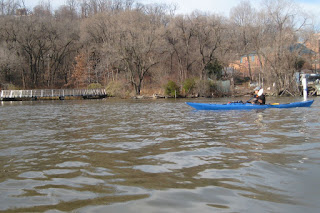
We decided to keep on, heading for the three bridges of Hamilton, Washington, and High Bridge. As we approached, the current abruptly changed, and we only made it to the first of these bridges before deciding to turn back.

Earlier, we realized we had not seen anyone else on the water - including motorized vessels. That changed as one of the Classic Harbor Line vessels (the Manhattan) approached and passed us by.

We paddled back and landed at the near near Peter Sharp, aka Swindler's Cove. We took an extended break, used the local facilities, took pictures, talked about things going on in the club. We watched the tide drain out, leaving our boats high and dry. We hoped in and paddled around, stopping in a nearby marsh area first.
I like to chase wildlife. Geese are pretty patient; Mallards will take flight at a greater distance. Whatever these birds were, they allowed me to tail them, riding in their wake.

Generally, conditions in both the Harlem and the Hudson were very calm. With slow current, the water became glass-like, lending itself to plenty of reflective images such as this.

As we went back, I snapped this shot of the Spuyten Duyvil railroad bridge. We watched it move from closed to open, to closed again, locking into place with a distinctive sound.

And that was our trip. The current had tuned while we were out, making for a much easier trip on the way back.
I'll write in more detail about the drysuit separately, but generally, it works really well - though I haven't put it through trials yet. I do tend to retain a lot of heat, and need to adjust my layering underneath, and I'm still perfecting my acrobatic routine for donning and exiting the suit. However, it isn't hard to paddle in, and I'm looking forward to more paddling further into the winter season.
Last weekend - the 8th - I went to the Inwood Canoe Club intending to work on a boat I've been repairing, and then to go for a paddle. As it happened, I ran in to one of the club officers, KM, who was heading out for a paddle. I reversed my plans, paddling with him before coming back to work on the boat.
The current was near max ebb as we headed north, making for a hard paddle up the river. Wind was coming from the west, so as we made the turn to go into Spuyten Duyvil, there were some squirrelly currents to deal with. Once we were in the Harlem River, however, both the wind and current died down a bit, and we had an easier time. We made it as far as the Broadway Bridge before turning around and heading back - much easier as drifted back with the current.
Yesterday, I went out with AA, another friend from the club. We timed our trip with the current, riding up the Hudson quickly and into the Harlem.
As we came up by Peter Sharp, we too in the coastline. Accustomed to spring and summer, the most noticeable difference is that with a lack of foliage, much more is visible.

Paddling Past the Park.
We decided to keep on, heading for the three bridges of Hamilton, Washington, and High Bridge. As we approached, the current abruptly changed, and we only made it to the first of these bridges before deciding to turn back.

The Hamilton, Washington, and High bridges.
Earlier, we realized we had not seen anyone else on the water - including motorized vessels. That changed as one of the Classic Harbor Line vessels (the Manhattan) approached and passed us by.

The commercial touring yacht Manhattan.
We paddled back and landed at the near near Peter Sharp, aka Swindler's Cove. We took an extended break, used the local facilities, took pictures, talked about things going on in the club. We watched the tide drain out, leaving our boats high and dry. We hoped in and paddled around, stopping in a nearby marsh area first.
I like to chase wildlife. Geese are pretty patient; Mallards will take flight at a greater distance. Whatever these birds were, they allowed me to tail them, riding in their wake.

Birds on the Water, Harlem River, New York.
Generally, conditions in both the Harlem and the Hudson were very calm. With slow current, the water became glass-like, lending itself to plenty of reflective images such as this.

Bronx Buildings Reflected
As we went back, I snapped this shot of the Spuyten Duyvil railroad bridge. We watched it move from closed to open, to closed again, locking into place with a distinctive sound.

And that was our trip. The current had tuned while we were out, making for a much easier trip on the way back.
I'll write in more detail about the drysuit separately, but generally, it works really well - though I haven't put it through trials yet. I do tend to retain a lot of heat, and need to adjust my layering underneath, and I'm still perfecting my acrobatic routine for donning and exiting the suit. However, it isn't hard to paddle in, and I'm looking forward to more paddling further into the winter season.
Saturday, November 24, 2012
Thanksgiving Paddle
I went paddling with a friend on the Friday after Thanksgiving. The air temperature was predicted to be relatively warm, in the low fifties, and the rest of the forecast was otherwise acceptable. AW and I met at the Inwood Canoe Club, and went out for a couple of hours, heading south against the current and crossing the river, before heading back with the flood tide.

Details for the more technically inclined: because the water temperature is dropping, AW wore her drysuit over layers. I wore a wetsuit with a Kokotat Tropos jacket and waterproof pants, along with some new Kokotat water boots. Unlike scuba diving shoes, the sole is hard, making them better for bracing against foot pegs.
Since the Argonaut (my boat) is rapped at the still-closed Pier 96, I paddled a club Looksha IV. I have most of my gear, including my sprayskirt, so it wasn't too different from how I usually paddle. The main difference is that the Looksha has a rudder system rather than a skeg, as my boat does. I would be missing that skeg later in the trip. AW paddled her Tiderace Xplore-S.
While we got ready, we saw another paddler in a short boat making his way down and across the river. We caught up with him later. His name was Dan Barron, paddling a surf kayak. He had launched at the beach at Dyckman, just north of us, and was on his way back when we caught up with him just north of Riverbank State Park.
AW headed down on the Manhattan side, with no particular destination in mind. The current was already flooding in, and would hit max flood about two hours after we left, so the current was increasingly against us as we went. We figured we would get as far as 125th street, and maybe cross the river earlier. Since we felt like we were doing well, we crossed below the George Washington Bridge, and then made our way south. We made it as far as the Ferryboat Binghamton, but not to our reach destination of Mitsuwa. While not much further, if we had gone there, we would have have simply turned right around in order to cross the river before it got too dark to be safe. We only had one light between us and didn't want to risk crossing without more lights.

Traffic was on the light side. We only saw a couple of motor boats, and only one barge, much farther down the river than we were going. There was a DEP boat at Riverbank, which slipped its mooring and headed south while we were resting across the river. There was a NY Waterways ferry coming and going from Edgewater; we saw it a couple of times. Otherwise, however, traffic was very quiet, and we were able to enjoy the scenery.
The foliage along the river really was hitting its autumnal bloom. There were gorgeous red anr orange leaves, many falling into the river. We took in some of the new construction along the bike path being created south of the boathouse, and spotted some new ramshackle fishing holes - bespoke wooden shanties along the river that locals fish from. We saw some guys fishing, and we also saw what looked like a volunteer trash cleanup on the rocks just north of the Manhattan tower on the GWB. We also saw some new decorative detritus - a guitar panel hanging from a tree, and a speed limit sign resting on a rock, facing out on the river. This was a land-based sign, mind you, advising speeds no faster than forty miles per hour.
Not too long after we left, I spotted a bottle floating in the water. I paddled close to look at it, becase it looked unusual. I was a wine bottle than someone had turned into a 'message in a bottle', complete with phone number to call. I kept it with me to look at when we got back.
As we paddled, the wind picked up, and after crossing the river, it tended to cock my boat to the left. I did a lot of sweep strokes to the left as we made our way down. On the way back, after crossing the river, the wind changed direction, and tended to cock my boat towards the right, towards Manhattan, when I wanted to go north. The wind didn't feel strong, but the apparent motion of the river was east too west, rather than north, as the current was flowing. It was frustrating, but by taking a couple of breaks, I managed to keep the boat headed in the right direction despite the wind.
When we got back, we tried opening the bottle, but it the message was wet inside. I took it home and, after washing the bottle, let it dry with my other gear, eventually using a hair dryer to dry the message out. It came out in two pieces, which, once put back together, spelled out a message of: Thanksgiving 2K12.
I've been considering a drysuit lately, and this paddle certainly makes me want to continue paddling through the winter - for self-maintenance if nothing else. I was surprised at how out of shape I felt after just a month of not paddling. I want to continue paddling in order to keep my skills up, as well as to stay in good physical shape. I have a lot of paddling planned for next summer, and I can't be starting over physically in May.

Looking South at the GWB
Details for the more technically inclined: because the water temperature is dropping, AW wore her drysuit over layers. I wore a wetsuit with a Kokotat Tropos jacket and waterproof pants, along with some new Kokotat water boots. Unlike scuba diving shoes, the sole is hard, making them better for bracing against foot pegs.
Since the Argonaut (my boat) is rapped at the still-closed Pier 96, I paddled a club Looksha IV. I have most of my gear, including my sprayskirt, so it wasn't too different from how I usually paddle. The main difference is that the Looksha has a rudder system rather than a skeg, as my boat does. I would be missing that skeg later in the trip. AW paddled her Tiderace Xplore-S.
While we got ready, we saw another paddler in a short boat making his way down and across the river. We caught up with him later. His name was Dan Barron, paddling a surf kayak. He had launched at the beach at Dyckman, just north of us, and was on his way back when we caught up with him just north of Riverbank State Park.
AW headed down on the Manhattan side, with no particular destination in mind. The current was already flooding in, and would hit max flood about two hours after we left, so the current was increasingly against us as we went. We figured we would get as far as 125th street, and maybe cross the river earlier. Since we felt like we were doing well, we crossed below the George Washington Bridge, and then made our way south. We made it as far as the Ferryboat Binghamton, but not to our reach destination of Mitsuwa. While not much further, if we had gone there, we would have have simply turned right around in order to cross the river before it got too dark to be safe. We only had one light between us and didn't want to risk crossing without more lights.

The Ferryboat Binghamton, November 2012
Traffic was on the light side. We only saw a couple of motor boats, and only one barge, much farther down the river than we were going. There was a DEP boat at Riverbank, which slipped its mooring and headed south while we were resting across the river. There was a NY Waterways ferry coming and going from Edgewater; we saw it a couple of times. Otherwise, however, traffic was very quiet, and we were able to enjoy the scenery.
The foliage along the river really was hitting its autumnal bloom. There were gorgeous red anr orange leaves, many falling into the river. We took in some of the new construction along the bike path being created south of the boathouse, and spotted some new ramshackle fishing holes - bespoke wooden shanties along the river that locals fish from. We saw some guys fishing, and we also saw what looked like a volunteer trash cleanup on the rocks just north of the Manhattan tower on the GWB. We also saw some new decorative detritus - a guitar panel hanging from a tree, and a speed limit sign resting on a rock, facing out on the river. This was a land-based sign, mind you, advising speeds no faster than forty miles per hour.
Not too long after we left, I spotted a bottle floating in the water. I paddled close to look at it, becase it looked unusual. I was a wine bottle than someone had turned into a 'message in a bottle', complete with phone number to call. I kept it with me to look at when we got back.
As we paddled, the wind picked up, and after crossing the river, it tended to cock my boat to the left. I did a lot of sweep strokes to the left as we made our way down. On the way back, after crossing the river, the wind changed direction, and tended to cock my boat towards the right, towards Manhattan, when I wanted to go north. The wind didn't feel strong, but the apparent motion of the river was east too west, rather than north, as the current was flowing. It was frustrating, but by taking a couple of breaks, I managed to keep the boat headed in the right direction despite the wind.
When we got back, we tried opening the bottle, but it the message was wet inside. I took it home and, after washing the bottle, let it dry with my other gear, eventually using a hair dryer to dry the message out. It came out in two pieces, which, once put back together, spelled out a message of: Thanksgiving 2K12.
I've been considering a drysuit lately, and this paddle certainly makes me want to continue paddling through the winter - for self-maintenance if nothing else. I was surprised at how out of shape I felt after just a month of not paddling. I want to continue paddling in order to keep my skills up, as well as to stay in good physical shape. I have a lot of paddling planned for next summer, and I can't be starting over physically in May.
Thursday, November 8, 2012
Sandy
A hurricane - wait, it wasn't, it was a large storm - whatever it was, Sandy hit New York City last week. More accurately, it made landfall on the eastern seaboard, devastating beach communities in New Jersey, Staten Island, and Long Island. Power was knocked out for millions in the region, and massive flooding drowned lower Manhattan to a level where some buildings won't be usable for weeks.
Relevant to this blog, the flooding came up very high at both of the boathouses I paddle out of. At Pier 96, the water came into the boathouse to about four feet high, depositing a thin layer of mud on the concrete floor. At Inwood Canoe Club, the water came up higher because the boathouse sits lower. The flooding lifted the launch dock higher than the main dock, and swept away portions of the retaining wall that holds dirt onto the island.
In both cases, the clubs had taken measures to lift everything up high that had to be and could be. Paddles, floats, papers, electronics - everything went up or went away. fiberglass boats were lifted to at least four feet off the ground. I'm happy to say the Argonaut, ten feet up and as high as could be, survived without incident. the only damage, such as it was, was mostly cosmetic to the boathouses. In the case of Pier 96, the Hudson River Park Trust is tackling the major repairs, and at Inwood, the club is putting together a plan to replace lost soil, repair the walls, and clean the place up.
In both cases, work days after the storm cleared away the detritus that washed in, and through out the wreckage of what was left. The boathouses are in good shape, though there is still work to be done at each.
This is all a long way of saying I haven't been out on the water recently. There is a possibility of getting out this weekend, but following the storm, there was a sudden drop in temperature, and as the weeks roll by, we'll soon be in drysuit-only season.
But fear not! The cowgirl has prepared for this contingency, and if she's not out paddling, she'll be blogging, and writing down kayak-related thoughts that she hasn't had time for in the regular paddling season.
Relevant to this blog, the flooding came up very high at both of the boathouses I paddle out of. At Pier 96, the water came into the boathouse to about four feet high, depositing a thin layer of mud on the concrete floor. At Inwood Canoe Club, the water came up higher because the boathouse sits lower. The flooding lifted the launch dock higher than the main dock, and swept away portions of the retaining wall that holds dirt onto the island.
In both cases, the clubs had taken measures to lift everything up high that had to be and could be. Paddles, floats, papers, electronics - everything went up or went away. fiberglass boats were lifted to at least four feet off the ground. I'm happy to say the Argonaut, ten feet up and as high as could be, survived without incident. the only damage, such as it was, was mostly cosmetic to the boathouses. In the case of Pier 96, the Hudson River Park Trust is tackling the major repairs, and at Inwood, the club is putting together a plan to replace lost soil, repair the walls, and clean the place up.
In both cases, work days after the storm cleared away the detritus that washed in, and through out the wreckage of what was left. The boathouses are in good shape, though there is still work to be done at each.
This is all a long way of saying I haven't been out on the water recently. There is a possibility of getting out this weekend, but following the storm, there was a sudden drop in temperature, and as the weeks roll by, we'll soon be in drysuit-only season.
But fear not! The cowgirl has prepared for this contingency, and if she's not out paddling, she'll be blogging, and writing down kayak-related thoughts that she hasn't had time for in the regular paddling season.
Subscribe to:
Posts (Atom)