This cowgirl had to lasso one of her charges today. I had to actually rescue someone in current after they fell out of their boat.
In the clubs I'm in, we practice this. We practice assisted rescue and self rescue. We practice being the rescuer, and being rescued. We practice with sit-on-top (SOT) kayaks and deck boats - what most people picture as kayaking, where you sit inside the boat, usually with a spray skirt. Rolling is a kind of self-rescue.
What happened was: at 72nd street, the current was relativel strong. We communicated the boundaries of where we wanted people to paddle, and explicitly said "stay away from ships". One of the public had paddled out past the outer boundary and was headed - quickly, aided by current - to a catamaran moored at the southwest corner of the boundary.
As soon as I was about to tell him to come back closer, he hit one of the mooring lines, and went in the water, his boat upside down.
Now, two things: first, this is not in itself life-threatening, or leading to injury. He was wearing a PFD, and he was holding on to the boat and his paddle. The current was relatively strong, but this is the Hudson River, not some wild rapids. He was floating on an escalator, and we needed to get him out.
That said, once someone is in the water, it's kinda serious. You have to get them out, and get them under their own power. Until they are safe, you never know what their status is. They might have had an aneurysm, or something similarly sudden and debilitating.
"Oh shit, " I muttered to myself, and hopped in our safety boat - a long, narrow scupper perfect for rushing to the rescue, tow bag in my lap.
When I got out there, I remembered all our practice. "Are you OK," I asked, and he said yes. I pulled alongside and told him to hold on to the boat, and then to hand me his paddle. Then I righted his boat. Then I held his boat and told him to kick his legs straight out and reach across to my boat. He did all that, and was able to pull himself on to his. I got him to turn so he was seated properly, and then got him back to the dock.
In all that - from the moment he went in, to the moment we were heading back - he had floated about 35 yards. That put him halfway to a pedestrian pier that he would have either passed under (safely) or passed by.
After that, I kept a closer eye on our charges, and hollered at them if they got anywhere near the edge, or near a boat. A couple of girls who were kind of larking, I pulled in for a warning and used him as an example.
It's an odd situation to be in - promoting the use of the waterfront for recreation, yet also teaching people to be respectful of it. It all worked out well, and it was nice to know I could pass when my skills were put to the test. It was not an emergency, but it could have become one.
I'm happy I was able to help.
Sunday, July 29, 2012

72nd Street
Today I volunteered at 72nd street, opening the facility and putting people in boats. It's where I started volunteering, and while I've moved to other sites as I've moved around the city, I spent so much time learning there that I still feel a connection there.
The kayaking spot at 72nd is part of the Downtown Boathouse, (DTBH). It was an accidental spot, I'm told; after another site fell through, it ended up being the next best option. It's typically the busiest in any given summer, and has many more families due to its proximity to the residential buildings of the Upper West Side.
It's a labor of love, and the volunteers who keep it running every summer are a dedicated lot. First of all, all of the storage is in shipping containers about 200 feet away, underneath a highway and behind some basketball courts. To open up or put things away, you have to maneuver past ball players, cyclists, rollerbladers, and runners.
What gets moved is much easier this year. Volunteers still have to move out clothing racks holding life vests, two sets of metal lockers on narrow wheels, but they no longer have to cart boats along the path. Boats are now stored on the floating dock, secured with thick cables and locks. Those carts are heavy though, and must be pulled up one side of a hill, and then prevented from running away down the other side.
The water is not quite as protected as Pier 96. The water flows pretty strongly at times, and the public has to be watched a little more carefully to make sure they don't drift away. Furthermore, the outer edges are mooring spots for pleasure boats: catamarans, sailboats, and motor boats.
Where other sites have mostly young adults looking for something new, 72nd has a lot of families, and a lot of drop-ins from runners and bicyclists.
To get to to 72nd, go all th west end of 72nd, before it comes off the highway. Enter the park (by Eleanor Roosevelt) and keep walking west - down the stairs, past the little league ballfields. Open Saturdays and Sundays about 10-5, and also holiday Mondays.
The kayaking spot at 72nd is part of the Downtown Boathouse, (DTBH). It was an accidental spot, I'm told; after another site fell through, it ended up being the next best option. It's typically the busiest in any given summer, and has many more families due to its proximity to the residential buildings of the Upper West Side.
It's a labor of love, and the volunteers who keep it running every summer are a dedicated lot. First of all, all of the storage is in shipping containers about 200 feet away, underneath a highway and behind some basketball courts. To open up or put things away, you have to maneuver past ball players, cyclists, rollerbladers, and runners.
What gets moved is much easier this year. Volunteers still have to move out clothing racks holding life vests, two sets of metal lockers on narrow wheels, but they no longer have to cart boats along the path. Boats are now stored on the floating dock, secured with thick cables and locks. Those carts are heavy though, and must be pulled up one side of a hill, and then prevented from running away down the other side.
The water is not quite as protected as Pier 96. The water flows pretty strongly at times, and the public has to be watched a little more carefully to make sure they don't drift away. Furthermore, the outer edges are mooring spots for pleasure boats: catamarans, sailboats, and motor boats.
Where other sites have mostly young adults looking for something new, 72nd has a lot of families, and a lot of drop-ins from runners and bicyclists.
To get to to 72nd, go all th west end of 72nd, before it comes off the highway. Enter the park (by Eleanor Roosevelt) and keep walking west - down the stairs, past the little league ballfields. Open Saturdays and Sundays about 10-5, and also holiday Mondays.
Friday, July 27, 2012
Rolling
This cowgirl was finally able to roll her boat, at least once.
I won't go into the different kinds of rolls, or rolling techniques. I will say I rolled using a technique I had not previously had success with, where basically my hands are in the position they are when I paddle. The idea is, if I go in when under way, I'm not going to be taking time to set everything up just so.
I tried a second time, and flubbed it. Actually, what happened was, the paddle seemed to get tangled on something behind me on the back deck of my boat, likely the paddle float. So, I'll be looking for a different way to dress my boat.
What's important is, I did it. My boat is a bit large for me. I tend to pry myself out of the boat rather than righting it. So, I know it can be done. All it takes now is practice, practice, practice, and pretty soon, I'll be kayaking in Carnegie Hall.
I won't go into the different kinds of rolls, or rolling techniques. I will say I rolled using a technique I had not previously had success with, where basically my hands are in the position they are when I paddle. The idea is, if I go in when under way, I'm not going to be taking time to set everything up just so.
I tried a second time, and flubbed it. Actually, what happened was, the paddle seemed to get tangled on something behind me on the back deck of my boat, likely the paddle float. So, I'll be looking for a different way to dress my boat.
What's important is, I did it. My boat is a bit large for me. I tend to pry myself out of the boat rather than righting it. So, I know it can be done. All it takes now is practice, practice, practice, and pretty soon, I'll be kayaking in Carnegie Hall.
Wednesday, July 25, 2012
Sculling for Support
This evening I tried something called "sculling for support". It isn't new to me, but it's the skill I seem to be focused on improving lately.
Sculling for support is basically moving the paddle back and forth laterally on one side of the boat, and then leaning over the side of the boat, relying on the moving paddle to support you. It's not a move you make in motion, in the field, so to speak. It develops a skill that is useful in bracing and rolling. I'd like to get to where I can scull myself up from an inverted position.
People who are really good at this can lay the boat on its side and rest part of their weight on the PFDs (life jackets). The look frantic, but they're actually in a stable position as long as the paddle is moving, with the boat perpendicular to the water. If they go under, they scull themselves back up.
I can almost do what this guy is doing in the first clip:
http://www.youtube.com/watch?v=dTk5trsqyhk
This guy . . .I'm not there yet.
http://www.youtube.com/watch?v=inUjVzRiOaQ
Sculling for support is basically moving the paddle back and forth laterally on one side of the boat, and then leaning over the side of the boat, relying on the moving paddle to support you. It's not a move you make in motion, in the field, so to speak. It develops a skill that is useful in bracing and rolling. I'd like to get to where I can scull myself up from an inverted position.
People who are really good at this can lay the boat on its side and rest part of their weight on the PFDs (life jackets). The look frantic, but they're actually in a stable position as long as the paddle is moving, with the boat perpendicular to the water. If they go under, they scull themselves back up.
I can almost do what this guy is doing in the first clip:
http://www.youtube.com/watch?v=dTk5trsqyhk
This guy . . .I'm not there yet.
http://www.youtube.com/watch?v=inUjVzRiOaQ
Tuesday, July 24, 2012
Alpine
One of my goals has been to paddle north past Manhattan. Typical destinations include Yonkers, or Alpine, which is essentially a state park on the Jersey side, across the river from Yonkers. I planned a trip and invited some friends, and up the river we went on Saturday July 21.
This was a two-stage trip. I departed Pier 96 with two people, and we paddled north to Inwood, where we meet two other paddlers, one of whom was in a canoe. Fromm Pier 96 came MD, and VS, the latter having joined me on the trip to Staten Island last month, and in Inwood we were joined by AW and MH, the latter in his canoe.
The first thing to realize is that simply getting to Inwood alone is at least ten miles from Pier 96. With current, and taking time for conversation, we got there in about two hours. VS gets extra credit for paddling up from Pier 66 earlier.
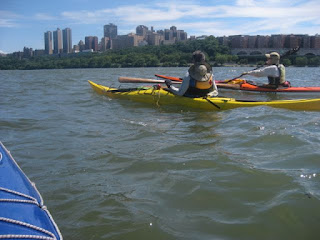


It's hard to describe how beautiful the Palisades are. They're majestic - tall cliffs rising out of and looming over the river. They're green, covered in trees, with footpaths along the base; we could sometimes see hikers along the trail. It was hard to believe we were just a two or three hour paddle away from the city, easy distance from the largest and fourth-largest cities in New York State.


As we approached Alpine, we began to run out of current, and the last few miles were hot, tiring, and we were hungry. When we finally landed at a beach on the north end of the marina there, we quickly hopped out, pulled up our boats, and unpacked our picnic.
We also ran into CL and R, who ha set out for the same destination independently. In this photo are AW, MH, VS, MD, myself, and R. CL took the photo.

What a spread it was! I brought bratwurst, rolls, and mustard, as well as chips and soda and pie; MD brought hummus and tabuli; MH and AW both brought pasta and cookies. We ate our fill. We had more than enough food because some folks had backed out at the last minute. It was grand.
We waited for the tide to change; some folks paddled north to see what was around the bend. We were running late, so we couldn't stay quite as long as we had hoped - while the tides favored us going back, for those going back to 96, to stay too long would have put us at a disadvantage at the end. So, we lest around 430, with almost no traffic, and a glassy river glistening in the sun.

On our way back, we passed the Harlem River again, with the Henry Hudson Bridge arcing high over it, a little railroad bridge below it.


I have to say this is what I love about kayaking, and the city as well -to have such great distance, and such enormous scale and scope of human activity, contrasted with natural beauty and an intimacy with nature that rivals the state parks of the west. We went somewhere under out own power, enjoyed good company and food, and returned. On the way back, windows once again prevailed against the currents, kicking up sizable waves that were fun to surf. For about 45 minutes we were paddling in 2-foot or 3-foot troughs, rising up, punching through them, steadying with a brace, carried by the current.
This was a two-stage trip. I departed Pier 96 with two people, and we paddled north to Inwood, where we meet two other paddlers, one of whom was in a canoe. Fromm Pier 96 came MD, and VS, the latter having joined me on the trip to Staten Island last month, and in Inwood we were joined by AW and MH, the latter in his canoe.
The first thing to realize is that simply getting to Inwood alone is at least ten miles from Pier 96. With current, and taking time for conversation, we got there in about two hours. VS gets extra credit for paddling up from Pier 66 earlier.

We kept on the Manhattan side since we were going to Inwood. We wet out around the sanitation pier, past 72nd, past the marina and its mooring field, and plowed through some fun little waves. The wind was coming directly against the current, so it was just bumpy enough to be fun.
We stopped at Fairway on the way up - not getting out, just taking a break for water. A water main was spewing water into the river, but then went off. We weren't sure what that was about.
MD tried out his Greenland-style paddle. These are long sticks, usually made of wood, very narrow but supposedly providing the same surface area as modern paddles. I'd love to have one someday; MD has let me try his in the past, and it's a different paddling style. He wanted to see if he could use it as his primary paddle (it worked very well, I should say).
In Inwood, we were passed by a barge; the photo is a bit blurry but you can still see it. Barges are majestic, large, steadily-moving big beasts of burden on the river. They're easy to avoid - and you should - but beautiful to watch.

After picking up AW and MH, we set out, and in short order we were in territory I have not visited: we had passed the Harlem River and were paddling across the Bronx, where we allied up and crossed the river.

It's hard to describe how beautiful the Palisades are. They're majestic - tall cliffs rising out of and looming over the river. They're green, covered in trees, with footpaths along the base; we could sometimes see hikers along the trail. It was hard to believe we were just a two or three hour paddle away from the city, easy distance from the largest and fourth-largest cities in New York State.


As we approached Alpine, we began to run out of current, and the last few miles were hot, tiring, and we were hungry. When we finally landed at a beach on the north end of the marina there, we quickly hopped out, pulled up our boats, and unpacked our picnic.
We also ran into CL and R, who ha set out for the same destination independently. In this photo are AW, MH, VS, MD, myself, and R. CL took the photo.

What a spread it was! I brought bratwurst, rolls, and mustard, as well as chips and soda and pie; MD brought hummus and tabuli; MH and AW both brought pasta and cookies. We ate our fill. We had more than enough food because some folks had backed out at the last minute. It was grand.
We waited for the tide to change; some folks paddled north to see what was around the bend. We were running late, so we couldn't stay quite as long as we had hoped - while the tides favored us going back, for those going back to 96, to stay too long would have put us at a disadvantage at the end. So, we lest around 430, with almost no traffic, and a glassy river glistening in the sun.

On our way back, we passed the Harlem River again, with the Henry Hudson Bridge arcing high over it, a little railroad bridge below it.

From a distance, we could see Manhattan, the Georage Washington Bridge hanging in front of it, clouds passing by, so disparate we could see different weather patterns over different parts of the city.

I have to say this is what I love about kayaking, and the city as well -to have such great distance, and such enormous scale and scope of human activity, contrasted with natural beauty and an intimacy with nature that rivals the state parks of the west. We went somewhere under out own power, enjoyed good company and food, and returned. On the way back, windows once again prevailed against the currents, kicking up sizable waves that were fun to surf. For about 45 minutes we were paddling in 2-foot or 3-foot troughs, rising up, punching through them, steadying with a brace, carried by the current.
Monday, July 23, 2012
Salt
On a recent trip (to Alpine, which I'll detail later), I noticed something weird in my rash guard when we got out.
First, I noticed some weird stiffness, or pellets, in my elbows. Working my way around the area I found lumps in the fabric. They were embedded - not on top of, but practically of the fabric.
I was able to extract some. It was white and powdery, so I figured it must be salt.
That makes sense, given that we had paddled for 2.5 hours in the salty Hudson River, and had gotten some waves due to contra-current winds.
Some of it I couldn't get out. I'll see how it looks after a wash.
Guess I'm an "old salt" now with my long-distance paddling.
First, I noticed some weird stiffness, or pellets, in my elbows. Working my way around the area I found lumps in the fabric. They were embedded - not on top of, but practically of the fabric.
I was able to extract some. It was white and powdery, so I figured it must be salt.
That makes sense, given that we had paddled for 2.5 hours in the salty Hudson River, and had gotten some waves due to contra-current winds.
Some of it I couldn't get out. I'll see how it looks after a wash.
Guess I'm an "old salt" now with my long-distance paddling.
Monday, July 16, 2012
Leading the Public
Sunday morning, I co-led a public trip with MD. Helping us were S, E, and Sa (two guys with the same name starting with S). It was E's first public trip.
Public trips are one of the free programs the Downtown Boathouse (DTBH) operates. Basically, Saturday and Sunday mornings in the summer we will take a group of the "public" - walk-up participants - on a trip up or down the river. The usual requirements of an ability to swim and signing a waiver are in place, and it is strongly recommended people paddle in the embayment a few times to get used to the boat. We take half a dozen single-seat boats and four double-seat boats and come back in three hours or so.
On this trip we opted for Mitsuwa, the Japanese supermarket in Fort Lee. We would run out of current by the time we got there, wait a bit, then come back with current.
The day was incredibly muggy. Hot, sticky, and overcast to boot. There were predictions of scattered showers, up to 50% chance of rain. Rain isn't an issue, but lightning is.
We got the public situated - a series of steps that are long and boring to describe. Basically, we usually can't take everyone. We give them a brief primer on the trip, test their abilities in the embayment, and kick out anyone who might be problematic. We didn't kick anyone out.
In this case, we gave the benefit of doubt to a mother-daughter pairing in a double. The mom was OK, but the daughter was kind of useless. We guessed she was being dragged along on a Bonding Experience. To be fair, once we got underway, after quite a bit of at-sea coaching, they were able to make headway, but it took them a while, and we had to keep an eye on them.
Public trips are where I most feel like a kayak cowgirl. We shepherd the public along, making sure they stay where it's safe, herding them from one point to another. They're slower than the typical pace of an experienced group - lots of time figuratively gripping the pommel, reins in hand - move along, little doggies, move along.
We made our way north past now-familiar landmarks - Pier I, the Boat Basin, the mooring field. We stopped for a water twice before even crossing the weather - the heat and humidity were just draining us in our exertions. We lined up around 96th street, and then crossed the river, where we took water again and then headed north.
We stopped again to let people catch up. By then, the current was starting to turn, and the weaker paddlers were getting strung out. As we got underway, after some effort, the mother-daughter team had tone towed by two volunteers. They had done well, but against the current was too much for them.
We landed at Mitsuwa. The first thing I noticed was that with the current running out, it was turning into a mud flat, a characteristic I'm already familiar with at that landing. We got everyone out but were keenly aware our time was limited.
We took a relatively short break. Often, we take an hour or more, but in this case, it took us so long to get there that we couldn't stay long. I picked up some of my favorite Japanese groceries - including this sort of milk-juice drink, snacked and chatted a bit, and then got ready to go.
After I applied my sunscreen, several folks asked for it. I expect this to happen so I gave up my near-empty bottle, keeping the full stuff in my locker back at the boathouse.
Sure enough, when we launched, the mud beneath the waves was a quagmire. People lost shoes (and recovered them). We had to push the boats out pretty far in some cases because otherwise they were stuck in the mud. Once we got clear, we were OK, but it took some effort - and this is not a beach you want to be sliding around barefoot on. It's got glass and other sharp objects; it's not a pleasant place at low tide.
Paddling back was easy-peasy. We had good current, and therefore kept on the Jersey side. Before we crossed, we pulled into an embayment and encouraged people to "accidentally" fall in one at a time to cool off. Only a couple of people took advantage of our offer - possibly because the first person to do so cannonballed in and stood up in less than four feet of water. I hung of someone's bow and dipped myself in to cool off.
Coming back was . . .weird. First, there was traffic, which is OK and even typical; if anything, it was unusual that there had been almost no traffic when we crossed the first time. However, while waiting for a motorboat to pass, we noticed a ton of flashing lights on the traffic circle above the boat basin - all FDNY vehicles. Then we saw an FDNY boat zoom up the river and past the boat basin. We paddled a bit, then saw an NYPD boat, followed by an NYPD helicopter that ended up hovering over the boat basin. Then, we crossed a bit, and stopped as two more NYPD boats raced up the river. We also saw some crew boats hovering in the 72nd street embayment - my guess was they had radios and were waiting for traffic to clear. We finally crossed and went downtown, and saw a USCG helicopter flying north.
Now, these may have been unrelated events, but it sure seemed like they were related.
Overall it was a good trip. Mom and daughter did well on the way back - especially crossing. Everyone who left came back, and seemed satisfied. The only thing that marred the day was less about the trip - I noticed some cracks in my boat's gel coat, and I'll have to get them fixed, which is something of a hassle. I'm not sure where they came from but it doesn't matter - I can paddle a bit, but will need to get them fixed.
Public trips are one of the free programs the Downtown Boathouse (DTBH) operates. Basically, Saturday and Sunday mornings in the summer we will take a group of the "public" - walk-up participants - on a trip up or down the river. The usual requirements of an ability to swim and signing a waiver are in place, and it is strongly recommended people paddle in the embayment a few times to get used to the boat. We take half a dozen single-seat boats and four double-seat boats and come back in three hours or so.
On this trip we opted for Mitsuwa, the Japanese supermarket in Fort Lee. We would run out of current by the time we got there, wait a bit, then come back with current.
The day was incredibly muggy. Hot, sticky, and overcast to boot. There were predictions of scattered showers, up to 50% chance of rain. Rain isn't an issue, but lightning is.
We got the public situated - a series of steps that are long and boring to describe. Basically, we usually can't take everyone. We give them a brief primer on the trip, test their abilities in the embayment, and kick out anyone who might be problematic. We didn't kick anyone out.
In this case, we gave the benefit of doubt to a mother-daughter pairing in a double. The mom was OK, but the daughter was kind of useless. We guessed she was being dragged along on a Bonding Experience. To be fair, once we got underway, after quite a bit of at-sea coaching, they were able to make headway, but it took them a while, and we had to keep an eye on them.
Public trips are where I most feel like a kayak cowgirl. We shepherd the public along, making sure they stay where it's safe, herding them from one point to another. They're slower than the typical pace of an experienced group - lots of time figuratively gripping the pommel, reins in hand - move along, little doggies, move along.
We made our way north past now-familiar landmarks - Pier I, the Boat Basin, the mooring field. We stopped for a water twice before even crossing the weather - the heat and humidity were just draining us in our exertions. We lined up around 96th street, and then crossed the river, where we took water again and then headed north.
We stopped again to let people catch up. By then, the current was starting to turn, and the weaker paddlers were getting strung out. As we got underway, after some effort, the mother-daughter team had tone towed by two volunteers. They had done well, but against the current was too much for them.
We landed at Mitsuwa. The first thing I noticed was that with the current running out, it was turning into a mud flat, a characteristic I'm already familiar with at that landing. We got everyone out but were keenly aware our time was limited.
We took a relatively short break. Often, we take an hour or more, but in this case, it took us so long to get there that we couldn't stay long. I picked up some of my favorite Japanese groceries - including this sort of milk-juice drink, snacked and chatted a bit, and then got ready to go.
After I applied my sunscreen, several folks asked for it. I expect this to happen so I gave up my near-empty bottle, keeping the full stuff in my locker back at the boathouse.
Sure enough, when we launched, the mud beneath the waves was a quagmire. People lost shoes (and recovered them). We had to push the boats out pretty far in some cases because otherwise they were stuck in the mud. Once we got clear, we were OK, but it took some effort - and this is not a beach you want to be sliding around barefoot on. It's got glass and other sharp objects; it's not a pleasant place at low tide.
Paddling back was easy-peasy. We had good current, and therefore kept on the Jersey side. Before we crossed, we pulled into an embayment and encouraged people to "accidentally" fall in one at a time to cool off. Only a couple of people took advantage of our offer - possibly because the first person to do so cannonballed in and stood up in less than four feet of water. I hung of someone's bow and dipped myself in to cool off.
Coming back was . . .weird. First, there was traffic, which is OK and even typical; if anything, it was unusual that there had been almost no traffic when we crossed the first time. However, while waiting for a motorboat to pass, we noticed a ton of flashing lights on the traffic circle above the boat basin - all FDNY vehicles. Then we saw an FDNY boat zoom up the river and past the boat basin. We paddled a bit, then saw an NYPD boat, followed by an NYPD helicopter that ended up hovering over the boat basin. Then, we crossed a bit, and stopped as two more NYPD boats raced up the river. We also saw some crew boats hovering in the 72nd street embayment - my guess was they had radios and were waiting for traffic to clear. We finally crossed and went downtown, and saw a USCG helicopter flying north.
Now, these may have been unrelated events, but it sure seemed like they were related.
Overall it was a good trip. Mom and daughter did well on the way back - especially crossing. Everyone who left came back, and seemed satisfied. The only thing that marred the day was less about the trip - I noticed some cracks in my boat's gel coat, and I'll have to get them fixed, which is something of a hassle. I'm not sure where they came from but it doesn't matter - I can paddle a bit, but will need to get them fixed.
Subscribe to:
Posts (Atom)