I was immersed in the Westport River, awaiting rescue. This was during a class I was taking, in late June, with sunny skies and air temperatures in the eighties.
"Are you alright, Julie?"
"Yes," replied, "but I'll need to take a break after this." A moment later I thought to add, "I'm not kidding!" Sometimes my joviality masks real concern.
By the time I was climbing out of the water and into a canoe, my teeth were starting the chatter, and I sat out the next round of practice rescues practicing my "inner lizard", soaking in the sun, fully clad in wetsuit and booties, watching the other participants in my group sort a rescue.
I get cold easily. To be really clear, I have no complaints about the course or how it was managed, or any other course I've been on. In this case, I told the providers ahead of time I was bringing all my layers short of a drysuit, and I was never in real danger of hypothermia. They rotated me out, and the shop we were working out brought out a drytop before I could get to my car to grab my paddling jacket.
I'm no stranger to cold. Over the years, I've been careful to manage my temperature, even at the bewilderment of others. Generally to the effect of "it's such a nice day, you're overdressed." I wore a drysuit on a warm September day for my 3 Star assessment; I've worn my dry cag over neoprene on windless days in spring; I carry my paddling jacket and, nowadays, my storm cag, if I expect F3 winds or higher and being more than half an hour from shelter.
I've been on the fence about identifying myself as one who gets cold easily. Maybe conditions are actually chilly? Maybe other people are putting on a tougher front and what I feel is normal?
I'm considered quite skinny and lean - at 5'9" and about 130 lbs, I'm barely even stewpot material, let along a serving of protein when the aliens come to devour us all. Anecdata and some basic internet research leans toward the side of body fat being something of a shield against hypothermia, but not as simply as is commonly assumed. This article from Popular Science summarizes things nicely. This article on weather.com says much the same as well. Fat people might feel colder, but their core temperature is better protected.
For myself, the real chiller is wind. Immersion time is a close second. I might do a roll, or some rescue practice, in reasonable water temperatures, say the low seventies, as we had in Westport. But, once out, if I get a steady breeze, even a gentle borderline F2/F3 breeze, I chill pretty quick.
Immersion simply sucks my heat out. Cumulative immersion (multiple times in the water) and prolonged immersion (more than a minute or two) have their effects, even when layered to the nines, as a quick review of my cold water blogging reveals: a winter rescue and paddling session, my distinctions between cold water and winter paddling, and my first notes on cold water paddling.
Nowadays, I would bump my personal comfort level up a bit. I'm grabbing the drysuit in the low sixties, and keeping the neoprene on up to the low seventies. I might vary that based on risk of immersion.
The challenge I've had lately is managing exceedingly warm days when the water is quite chilly. Removable layers, and planning to cool off in the water if I do overheat, are my new tactic.
So, there I was, in water bordering 70s F, patiently awaiting my rescue; moments later, laying out in the sun to soak in its warming rays; a bit later, using a canoe as shelter against the wind until I got a jacket on.
Just the weekend prior, I'd taught a course at a lake and rented my neoprene to students. After just three immersions apiece, they were tuckered and a bit cool, and we took a break. I kept my jacket on, and adjusted my plan accordingly.
So, I'm officially someone who gets cold easily. I layer up, I keep a jacket and tea handy, even on warm days. As far as the tea goes, my worst case is that I make some iced tea when I get home.
Showing posts with label drysuit. Show all posts
Showing posts with label drysuit. Show all posts
Thursday, June 29, 2017

Tuesday, March 14, 2017
Drysuit Repair
A friend of mine bought a used drysuit last year, and despite having the latex gaskets replaced by the manufacturer, discovered in some recent pool sessions that it leaks. I offered to take a look at it while he's on vacation; here is what I've found.
The first trick was to find the leaks. The gaskets seemed fine, but throughout the drysuit, most of the sealing under the seam tape was dried and flaking away.
cc
In an early attempt, I sealed the gaskets for bag clips, and then inflated it using a SUP air pump.

I then wrestled it - which must have looked really interesting to any onlookers - compressing first the legs, then the body - listening and pressing my face up in places where I thought air was escaping. The legs seemed fine, but the body was leaking air. However, I couldn't determine exactly where it was escaping from.
I took it home and hung it in the shower, partially filling the drysuit with water and then letting it hang in different positions to see what leaked. This was an improvement, but still inexact. I couldn't see anything dripping from the legs, but clearly water was escaping along the chest zipper. It came down along the relief zipper as well, but not as much. However, it would run down the edge of the fabric and drip like a stalactite, so I wasn't sure where along the zipper it was leaking.

The next test helped me narrow down the leaks. Following advice from a friend, I smeared liquid soap all over the zippers and their seams. I then inflated it - with deep chest breaths, no pump, because I didn't have one with me - and then squeezed the body much as I had before.
I have to say, by this point my technique in compressing the drysuit to check different areas of its surface was much refined.
Lo and behold, little bubbles of soap appeared, in varying sizes, along the chest.


So, clearly not the zipper itself, but the seams around it.
If you look on the other side, you can see where there's just not much backing up the stitching.

The next step is to see if there is a good way to re-seal that seam. I'm guessing AquaSeal, or something similar, but I want to take time to consider how best to make it a continuous, singular spread. I don't want any gaps in coverage.
The first trick was to find the leaks. The gaskets seemed fine, but throughout the drysuit, most of the sealing under the seam tape was dried and flaking away.
cc
In an early attempt, I sealed the gaskets for bag clips, and then inflated it using a SUP air pump.

World's Funnest Inflatable Humanoid.
I then wrestled it - which must have looked really interesting to any onlookers - compressing first the legs, then the body - listening and pressing my face up in places where I thought air was escaping. The legs seemed fine, but the body was leaking air. However, I couldn't determine exactly where it was escaping from.
I took it home and hung it in the shower, partially filling the drysuit with water and then letting it hang in different positions to see what leaked. This was an improvement, but still inexact. I couldn't see anything dripping from the legs, but clearly water was escaping along the chest zipper. It came down along the relief zipper as well, but not as much. However, it would run down the edge of the fabric and drip like a stalactite, so I wasn't sure where along the zipper it was leaking.

Filled to the ankles.
The next test helped me narrow down the leaks. Following advice from a friend, I smeared liquid soap all over the zippers and their seams. I then inflated it - with deep chest breaths, no pump, because I didn't have one with me - and then squeezed the body much as I had before.
I have to say, by this point my technique in compressing the drysuit to check different areas of its surface was much refined.
Lo and behold, little bubbles of soap appeared, in varying sizes, along the chest.


So, clearly not the zipper itself, but the seams around it.
If you look on the other side, you can see where there's just not much backing up the stitching.

The next step is to see if there is a good way to re-seal that seam. I'm guessing AquaSeal, or something similar, but I want to take time to consider how best to make it a continuous, singular spread. I don't want any gaps in coverage.
Monday, January 16, 2017
Radius Drysut
Kayak Cowgirl and her trusty ol' Expedition drysuit, and Mr. Cowgirl in his fancy new Radius - Kokatat's top-of-the-line model that uses what they called SwitchZip, to zip together the top half and bottom half.
The zipper has to be fully seated before starting the zip. That can prove a bit tricky. Once started, though, it goes around and seals very well.

Once the zipper has come all the way around, the round knob clasps over the nut, then screws down tight to seal the zipper.

Compared to the more typical front-entry suits, this arrangement gives a smoother chest, and certainly makes "relief" much easier !
The suit has some other well-though-out touches. The hood is removable, secured with three velcro straps that weave under cord around the neck. The hood also has a side-mounted flap that snaps shut to cover the face, or snaps back to open it up. The neck area can open up for venting - not open to the interior of the suit, but essentially a fold of Gore-Tex over Gore-Tex in case of ice buildup. The suit's top and bottom have an extra flap of GoreTex to fold over the zipper, secured with velcro, so that when they are worn separated, the zipper is protected. Self-draining pockets on both arms and one leg complete the cargo layup, although oddly there is no chest pocket, as I've seen on the Expedition and Meridian.
All in all Mr. Cowgirl is happy with the drysuit, in particular the flexibility of SwitchZip - Kokatat already makes a compatible Anorak that zips on to the pants, so for low-risk touring, that might be preferable, in order to let out some heat. The removable hood was a key selling point, as his primary paddlesport is whitewater, where he doesn't want a hood.
The zipper has to be fully seated before starting the zip. That can prove a bit tricky. Once started, though, it goes around and seals very well.

It takes a steady hand.
Once the zipper has come all the way around, the round knob clasps over the nut, then screws down tight to seal the zipper.

Sealing the zipper.
Compared to the more typical front-entry suits, this arrangement gives a smoother chest, and certainly makes "relief" much easier !
The suit has some other well-though-out touches. The hood is removable, secured with three velcro straps that weave under cord around the neck. The hood also has a side-mounted flap that snaps shut to cover the face, or snaps back to open it up. The neck area can open up for venting - not open to the interior of the suit, but essentially a fold of Gore-Tex over Gore-Tex in case of ice buildup. The suit's top and bottom have an extra flap of GoreTex to fold over the zipper, secured with velcro, so that when they are worn separated, the zipper is protected. Self-draining pockets on both arms and one leg complete the cargo layup, although oddly there is no chest pocket, as I've seen on the Expedition and Meridian.
All in all Mr. Cowgirl is happy with the drysuit, in particular the flexibility of SwitchZip - Kokatat already makes a compatible Anorak that zips on to the pants, so for low-risk touring, that might be preferable, in order to let out some heat. The removable hood was a key selling point, as his primary paddlesport is whitewater, where he doesn't want a hood.
Friday, May 15, 2015
Cut Your Own Drysuit
A few months ago I paddled with some friends at the Inwood Canoe Club who'd bought some new drysuits. Inexpensive drysuits, at that. The quality seems good but there was one caveat - they had to cut their own gaskets.
xx
The suits basically come with standard rubber wrist and neck gaskets. However, they are completely sealed. It's hard to make out in this photo, but trust me friends there is no hole there. They had to cut the hole themselves.

The first step was to take a little nip - not big enough for head and neck, just enough to get a proper hole started.

After that they tried a technique seen on more customary neck gasket trimming: Poking a CD stack case evenly to stretch it out, and then running the sharpest blade availabled around it in one cut. Ideally this would have been an X-acto knife (or, "Blade of Exact Zero", if you will), but in this case the scissors were adequate.

They haven't gone on a "swim test" but the gaskets were certainly tight - my friends reported some additional trimming later on when they got home. These are unisex with limited sizing - not the sexiest suits we've seen, though they do make a big deal about having a flap to cover the front relief zipper, aka the pee-hole.
These drysuits are made and sold by Mythic Gear, http://www.mythicdrysuits.com/ . Check out their website for more information.
For myself, I'll stick with my Gore-tex drysuit, going on its fourth year with only one gasket replacement (which was my fault - my right hand got a little impatient once). There are other low-cost alternatives out there, including trilaminate materials, plastic zippers, and and open feet.
Before making any drysuit or cold-water paddling purchase, it's very important to have a solid understanding of cold water paddling, and knowledge of what a drysuit does and does not do.
That said, these semi-DYI suits are another option to consider.
xx
The suits basically come with standard rubber wrist and neck gaskets. However, they are completely sealed. It's hard to make out in this photo, but trust me friends there is no hole there. They had to cut the hole themselves.

The first step was to take a little nip - not big enough for head and neck, just enough to get a proper hole started.

After that they tried a technique seen on more customary neck gasket trimming: Poking a CD stack case evenly to stretch it out, and then running the sharpest blade availabled around it in one cut. Ideally this would have been an X-acto knife (or, "Blade of Exact Zero", if you will), but in this case the scissors were adequate.

They haven't gone on a "swim test" but the gaskets were certainly tight - my friends reported some additional trimming later on when they got home. These are unisex with limited sizing - not the sexiest suits we've seen, though they do make a big deal about having a flap to cover the front relief zipper, aka the pee-hole.
These drysuits are made and sold by Mythic Gear, http://www.mythicdrysuits.com/ . Check out their website for more information.
For myself, I'll stick with my Gore-tex drysuit, going on its fourth year with only one gasket replacement (which was my fault - my right hand got a little impatient once). There are other low-cost alternatives out there, including trilaminate materials, plastic zippers, and and open feet.
Before making any drysuit or cold-water paddling purchase, it's very important to have a solid understanding of cold water paddling, and knowledge of what a drysuit does and does not do.
That said, these semi-DYI suits are another option to consider.
Sunday, November 16, 2014
Drysuit Paddling
The first thing I feel is the impact of the water. If I'm perfectly lined up it's on my shoulder; if not, I take it on the cheek, cool brackish water slapping me in the face.
Then I'm under, and I feel my drysuit crinkle around me, air rushing to my arms and legs. I pull myself over and then sweep myself up.
Or, if I'm practicing re-entry and roll, I'm out of the boat, my feet in the cockpit while I sort my paddle, my legs inflated with whatever air was in the suit, and then I take a breath, stuff myself back in, assume the position, and roll on up. After than I'm sitting in six inches of water and wondering if I should even bother wringing my hair out.
At the shop, some of our students and other clients bought drysuits and have asked to continue paddling into the winter. So we've had a gradual introduction to drysuit paddling. For the record, the water temperature has been in the 50s Fahrenheit and dropping, yesterday 54 F.
Here are my observations.
Entering and Exiting the Suit: It's important to check and double-check all zippers; it isn't difficult to leave that last half inch open. Be sure to grab and hold open the gaskets and not just poke through them. Absolutely bilge the suit of internal air, not just before going out but every couple of hours if possible.
We had one student who, on a wet exit drill, could not get completely over because he had so much air in his suit. This made getting out of the boat difficult, flopping around like a fish until his legs were free.
Range of Motion: Drysuits allow for a range of motion, but do make the paddler bigger all around. I have to adjust my PFD sizing when I go to the drysuit, and I feel like I fill my boat more than I do in the summer, wearing only sandals and rash guards. I notice this the most getting in and out of the boat.
Temperature Management: This might be the biggest topic so I'll give it several grafs.
First of all drysuits keep you dry; they do not keep you warm. A drysuit is essentially a Ziploc bag shaped like a person, or a drybag for people. To stay warm, wear layers underneath.
One challenge in this part of the season, and in early spring, is that the air and water temperatures are very different: yesterday the water was in the 50s but the air was in the 30s, low forties by the time we were on the water. In the spring it's the opposite: the air warms up to the 60s but the water is still in the 50s, leading people to underestimate the potential risks.
On top of that, being on the water, and immersion in water, tends to be colder than street weather. Without protection, humans lost heat twenty-five times faster in water than in air. Even fully layered and in a drysuit, that water felt colder than the air did on land yesterday. Even out paddling, the proximity to water, with exposure to the wind, makes it feel colder.
Last weekend, one of the other students felt overheated as we talked through the float plan in the cozy confines of the classroom. He disappeared for a bit and, as we learned later, stripped down to his trunks. When he capsized later, he felt it. He was not in long enough for it to be debilitating but he was longing for his layers.
Second of all, drysuits work in both directions: as you paddle, you're going to sweat, and that sweat isn't going to leave the suit. So, however many layers you wear, you'll want to make sure you've got something that will carry that moisture out away from your body. Most athletic wear does this, and drysuit manufacturers have their own lines of products meant specifically for this in drysuits.
What you want to avoid is a scenario like the following: It's cold, so you dress warmly. You paddle for an hour, and then the day turns sunny. Now you're hot and sweaty and beginning to wonder if the drysuit was overkill. Then you stop for lunch, clouds obscure the sun, and now you're cold and clammy until you start paddling again.
So, layers: stay warm, manage moisture, and practice gradually.
Then I'm under, and I feel my drysuit crinkle around me, air rushing to my arms and legs. I pull myself over and then sweep myself up.
Or, if I'm practicing re-entry and roll, I'm out of the boat, my feet in the cockpit while I sort my paddle, my legs inflated with whatever air was in the suit, and then I take a breath, stuff myself back in, assume the position, and roll on up. After than I'm sitting in six inches of water and wondering if I should even bother wringing my hair out.
At the shop, some of our students and other clients bought drysuits and have asked to continue paddling into the winter. So we've had a gradual introduction to drysuit paddling. For the record, the water temperature has been in the 50s Fahrenheit and dropping, yesterday 54 F.
Here are my observations.
Entering and Exiting the Suit: It's important to check and double-check all zippers; it isn't difficult to leave that last half inch open. Be sure to grab and hold open the gaskets and not just poke through them. Absolutely bilge the suit of internal air, not just before going out but every couple of hours if possible.
We had one student who, on a wet exit drill, could not get completely over because he had so much air in his suit. This made getting out of the boat difficult, flopping around like a fish until his legs were free.
Range of Motion: Drysuits allow for a range of motion, but do make the paddler bigger all around. I have to adjust my PFD sizing when I go to the drysuit, and I feel like I fill my boat more than I do in the summer, wearing only sandals and rash guards. I notice this the most getting in and out of the boat.
Temperature Management: This might be the biggest topic so I'll give it several grafs.
First of all drysuits keep you dry; they do not keep you warm. A drysuit is essentially a Ziploc bag shaped like a person, or a drybag for people. To stay warm, wear layers underneath.
One challenge in this part of the season, and in early spring, is that the air and water temperatures are very different: yesterday the water was in the 50s but the air was in the 30s, low forties by the time we were on the water. In the spring it's the opposite: the air warms up to the 60s but the water is still in the 50s, leading people to underestimate the potential risks.
On top of that, being on the water, and immersion in water, tends to be colder than street weather. Without protection, humans lost heat twenty-five times faster in water than in air. Even fully layered and in a drysuit, that water felt colder than the air did on land yesterday. Even out paddling, the proximity to water, with exposure to the wind, makes it feel colder.
Last weekend, one of the other students felt overheated as we talked through the float plan in the cozy confines of the classroom. He disappeared for a bit and, as we learned later, stripped down to his trunks. When he capsized later, he felt it. He was not in long enough for it to be debilitating but he was longing for his layers.
Second of all, drysuits work in both directions: as you paddle, you're going to sweat, and that sweat isn't going to leave the suit. So, however many layers you wear, you'll want to make sure you've got something that will carry that moisture out away from your body. Most athletic wear does this, and drysuit manufacturers have their own lines of products meant specifically for this in drysuits.
What you want to avoid is a scenario like the following: It's cold, so you dress warmly. You paddle for an hour, and then the day turns sunny. Now you're hot and sweaty and beginning to wonder if the drysuit was overkill. Then you stop for lunch, clouds obscure the sun, and now you're cold and clammy until you start paddling again.
So, layers: stay warm, manage moisture, and practice gradually.
Monday, November 10, 2014
Cold Water Paddling
I sent an email to my club recently about cold water paddling. Given we're expecting a blast of cold this weekend, I figure I ought to cross-post here.
A lot of risks can be mitigated with a cautious float plan, gentle conditions, and going out in a group. Being able to self-rescue and rescue quickly help too.
You want to dress for the water, but be aware of what’s going on in the air as well. Once you’re wet, a steady breeze will chill you. Keep a paddling jacket handy just in case it gets wet and it’s windy.
Bring hot tea in a thermos that will keep it hot. Future you will thank present you. Hot chocolate is good too.
You lose body heat about 25x (twenty-five times) as fast in the water as you do in the air. So, if the water temperature if 56 degrees and it takes you two minutes to get back in your boat, imagine wearing what you are wearing if you stood outside for about an hour. Next, imagine being wet afterwards, losing heat at your normal rate.
Wear synthetic materials or wool. Wear layers. Start with something that will wick up sweat underneath, with additional material in the middle, and a windproof shell as your outermost layer. Bring spare clothes to change into later, either optionally or as necessary.
If the water temperature is:
70s F - rash guard; swimsuit
60s F - neoprene or similar insulation
Below 62 F - wetsuit
Below 50 F - drysuit
Drysuits keep you dry; they do not keep you warm. You will need to layer up underneath it just as you would for a walk in the park.
I get cold pretty easily so I end to progress sooner; your mileage may vary. I switch to a drysuit sooner because 1) I have one and 2) it simplifies everything.
The water temperature last night at Battery was 55 F. After Thanksgiving it will probably drop below 50F, then to the mid-thirties in January and February, and not above 50F until the very end of April. The anecdote is that there are more cold water incidents in April than any other month because the weather is nice, but the water is still crackin’ cold. Even in June it’s in the mid-sixties.
There is no reason to be afraid of cold water paddling. It’s quite nice and a nice contrast to summer. Safe paddling is all about risk management. Use your judgment, learn from others, and build experience.
Sunday, May 18, 2014
A Bridge Too Far
I had an idea to go north. I am trying to get myself into the habit of open-ended trips, loading up my boat to support all contingencies and adapting my plan to suit conditions. That said, I wanted a long paddle, to see just how far I could go. I figured I would head for the Tappan Zee Bridge, and stop short if I needed.
The original float plan was a little aggressive. High tide at Battery was 1300 on the dot, which meant I couldn't really get going before 1100 without fighting more than a little current. It also meant that I'd be arriving back at sundown, or later.
High Tide 1300
Low Tide 1900
Wind predicted to be 9 mph from the east.
1100 Depart
1200 Yonkers Water Treatment Plant
1300 Private Buoy
1400 Tappan Zee Bridge
Layover
1530 Return
1700 Piermont Pier
1800 Private Buoy
1900 Spuyten Duyvil
1930+ Inwood
I was looking forward to this trip all week, and packed and ready early, so I was on the water by 1025. A friend of mine had left earlier on a shorter trip north and I hoped to catch up with him, eddy-paddling as much as I could up the eastern side of the Hudson River. I never saw him - turns out, he crossed and went back down on the other side.
I made good time, hitting my first two waypoints at the same relative time (+1 hour, +2 hours) as my original plan. The day was beautiful, near-clear blue skies, a warm sun, and playful breeze. I passed some barges parked above Englewood Marina. There was hardly any other traffic on the way up.
In short order I was in Yonkers, then Dobbs Ferry, and then territory unknown to me. Most of the trips I've made up this far have been on the western side of the river. Here, I learned a lot of little township names, marking my way by train stations where I could see them: Greystone, Ardsley-on-Hudson, and so on.
I practiced landmark navigation, comparing what I saw with my chart. I found this to be really useful. I could see where I was by identifying landmarks on the chart. I could figure my aggregate speed by finding another landmark about a mile away and timing how long it took to paddle it, and also estimate how long it would take to get to a point by applying what I thought was my speed, +/- what I thought the tides were.
Onward I went, gradually realizing just how far I was headed. This was an open paddle, right? I wasn't dedicated to the Tappan Zee. I was just heading "north". But the bridge was right there. I was almost there.
Have I ever mentioned I am terrible at estimating distances? This was another thing I worked on. I could locate myself on the chart, and see how far I actually was from a landmark, telling myself, "that's how far a mile is".
Onwards I went. There are a a lot of neat little towns on the east side of the river - I don't know why my friends prefer the western side. But now I was opposite Piermont Marsh, a regular day trip for us, and soon north of Piermont Pier - into the "Tappan Zee", a sea, as the Dutch called it.

Passing under the bridge, I surveyed the various barges working to build the "new " Tappan Zee Bridge. I imagine that when it's finished it will be interesting to pass through, given a wider path over the river. As it turned out, President Obama made a speech with this bridge as a backdrop, a speech about infrastructure investment. No one asked why anyone ever though building a multi-lane highway bridge at the widest point in the river was a good idea. NYS lore has it that the governor at the time did it so that he had a key piece of infrastructure, just outside the jurisdiction of the multistate Port Authority, through which he could hand out patronage jobs.
Anyway.
Now I could see Tarrytown Light - just another mile or so. I could write about it, but someone else has done a better job. Around the corner was a beach, where I landed for lunch.

While there, I rested, and several passersby came along from a nearby park. A man with a camera walked past. Two fisherman went by; I would see them later having climbed out on the rocks of the lighthouse, catching a small fish after much effort. Some children came by and dipped their toes in the water, daring each other to drink it. None of them did.
The most interesting visitor was a Russian man, a big middle-aged bear of a man, who sat on a stump contemplating the water. He took off his shoes. He took off his socks. He took off his shirt, and then his pants! Now comfortably clad in only his skivvies, he waded into the water. He sat, soaking in the 44 degree water quite a while, before emerging and donning his clothes again.

I had marked the tide when I came in, and eventually noted its slow decline. Time to leave. I packed everything up, and set on my way. Heading out was pretty straightforward, but below the Tappan Zee I ran into a steady headwind. It would keep up for nearly two hours straight.
I rarely curse the weather. Sometimes I beseech it, like asking the water to talk to the wind and tell him to stop being a jerk. In my cosmology, they are siblings, sister and brother. But this wind would not stop. I muttered under my breath. I argued with the wind. The wind would stop when I stopped paddling and pick up again when I did. Finally, I yelled at the wind before hunkering down and jus slogging through, muddling along until the current picked up and I got some nice little waves to play in on the way home.
I got back at 2000 or so - just a little later than planned, and not bad considering that after my head start, I fought headwind for two hours on the return. MH was waiting for me. He paddles evenings and had already come and gone, but stayed bc he noticed I was out "north" a bit early and hadn't come back yet.
I was tired, but not exhausted, not hypothermic or hypoglycemic or any of that So we caught up, and I washed up. We saw two kayaks go by and only learned later who they were. My inspiration, on a trip I aspire to!
All in all it was a good trip. I took a chance, paddling along so far so early in the year, but the worst I expected, and encountered, was wind, and even that was more annoying that terrible. It was a bonnie day, and I proved to myself how far I could go. I do need to improve my long-term paddling posture, but I ate well and planned well. Which, life doesn't always cooperate this handily but it's nice when it does.
The original float plan was a little aggressive. High tide at Battery was 1300 on the dot, which meant I couldn't really get going before 1100 without fighting more than a little current. It also meant that I'd be arriving back at sundown, or later.
High Tide 1300
Low Tide 1900
Wind predicted to be 9 mph from the east.
1100 Depart
1200 Yonkers Water Treatment Plant
1300 Private Buoy
1400 Tappan Zee Bridge
Layover
1530 Return
1700 Piermont Pier
1800 Private Buoy
1900 Spuyten Duyvil
1930+ Inwood
I was looking forward to this trip all week, and packed and ready early, so I was on the water by 1025. A friend of mine had left earlier on a shorter trip north and I hoped to catch up with him, eddy-paddling as much as I could up the eastern side of the Hudson River. I never saw him - turns out, he crossed and went back down on the other side.
I made good time, hitting my first two waypoints at the same relative time (+1 hour, +2 hours) as my original plan. The day was beautiful, near-clear blue skies, a warm sun, and playful breeze. I passed some barges parked above Englewood Marina. There was hardly any other traffic on the way up.
In short order I was in Yonkers, then Dobbs Ferry, and then territory unknown to me. Most of the trips I've made up this far have been on the western side of the river. Here, I learned a lot of little township names, marking my way by train stations where I could see them: Greystone, Ardsley-on-Hudson, and so on.
I practiced landmark navigation, comparing what I saw with my chart. I found this to be really useful. I could see where I was by identifying landmarks on the chart. I could figure my aggregate speed by finding another landmark about a mile away and timing how long it took to paddle it, and also estimate how long it would take to get to a point by applying what I thought was my speed, +/- what I thought the tides were.
Onward I went, gradually realizing just how far I was headed. This was an open paddle, right? I wasn't dedicated to the Tappan Zee. I was just heading "north". But the bridge was right there. I was almost there.
Have I ever mentioned I am terrible at estimating distances? This was another thing I worked on. I could locate myself on the chart, and see how far I actually was from a landmark, telling myself, "that's how far a mile is".
Onwards I went. There are a a lot of neat little towns on the east side of the river - I don't know why my friends prefer the western side. But now I was opposite Piermont Marsh, a regular day trip for us, and soon north of Piermont Pier - into the "Tappan Zee", a sea, as the Dutch called it.
Passing under the bridge, I surveyed the various barges working to build the "new " Tappan Zee Bridge. I imagine that when it's finished it will be interesting to pass through, given a wider path over the river. As it turned out, President Obama made a speech with this bridge as a backdrop, a speech about infrastructure investment. No one asked why anyone ever though building a multi-lane highway bridge at the widest point in the river was a good idea. NYS lore has it that the governor at the time did it so that he had a key piece of infrastructure, just outside the jurisdiction of the multistate Port Authority, through which he could hand out patronage jobs.
Anyway.
Now I could see Tarrytown Light - just another mile or so. I could write about it, but someone else has done a better job. Around the corner was a beach, where I landed for lunch.
While there, I rested, and several passersby came along from a nearby park. A man with a camera walked past. Two fisherman went by; I would see them later having climbed out on the rocks of the lighthouse, catching a small fish after much effort. Some children came by and dipped their toes in the water, daring each other to drink it. None of them did.
The most interesting visitor was a Russian man, a big middle-aged bear of a man, who sat on a stump contemplating the water. He took off his shoes. He took off his socks. He took off his shirt, and then his pants! Now comfortably clad in only his skivvies, he waded into the water. He sat, soaking in the 44 degree water quite a while, before emerging and donning his clothes again.
I had marked the tide when I came in, and eventually noted its slow decline. Time to leave. I packed everything up, and set on my way. Heading out was pretty straightforward, but below the Tappan Zee I ran into a steady headwind. It would keep up for nearly two hours straight.
I rarely curse the weather. Sometimes I beseech it, like asking the water to talk to the wind and tell him to stop being a jerk. In my cosmology, they are siblings, sister and brother. But this wind would not stop. I muttered under my breath. I argued with the wind. The wind would stop when I stopped paddling and pick up again when I did. Finally, I yelled at the wind before hunkering down and jus slogging through, muddling along until the current picked up and I got some nice little waves to play in on the way home.
I got back at 2000 or so - just a little later than planned, and not bad considering that after my head start, I fought headwind for two hours on the return. MH was waiting for me. He paddles evenings and had already come and gone, but stayed bc he noticed I was out "north" a bit early and hadn't come back yet.
I was tired, but not exhausted, not hypothermic or hypoglycemic or any of that So we caught up, and I washed up. We saw two kayaks go by and only learned later who they were. My inspiration, on a trip I aspire to!
All in all it was a good trip. I took a chance, paddling along so far so early in the year, but the worst I expected, and encountered, was wind, and even that was more annoying that terrible. It was a bonnie day, and I proved to myself how far I could go. I do need to improve my long-term paddling posture, but I ate well and planned well. Which, life doesn't always cooperate this handily but it's nice when it does.
Monday, February 18, 2013
Notes: Drysuit
I bought a drysuit this year. Not only did I buy a drysuit, but I bought a pretty high-end one. I got a good deal on it, as it was an older model, and also had some cosmetic blemishes that brought the price down close to the high end of my budget. I bought it not only because I wanted to paddle in winter, but to comfortably extend the ends of the paddling season into periods when the water would be cold despite reasonable air temperatures.
W hile there are many manufacturers, most have a light layer and a heavy layer of materials to choose from; in my case, I went with the heavy-layer Kokotat Gore-Tex Expedition WFR (Women's with Front Relief). It's essentially a (wo)man-shaped Gore-Tex bag with latex gaskets at the wrist and neck, and a heavy zipper running diagonally from the right shoulder the left waist. "These zippers are the same kind they use in body bags," said the man at the shop. He would know: He also works as an EMT.
Regardless of material, the idea of a drysuit is true across all models: to keep its wearer dry. A drysuit does not keep one warm; it only keeps one dry. It's like wearing a plastic bag. Staying dry in cold weather is imperative; humans lose body heat in water at a rate about 25 times faster than in air. That is, if you stop functioning after thirty minutes standing on the street at twenty-eight degrees F, then in the water, you would would last just over a minute. Furthermore, layers of clothes don't help in water much; you're still wet and losing heat. On top of all that, God help you if the wind picks up while you're wet. Wind chill can be deadly.
A drysuit's waterproof materials and gaskets keep the interior of the suit dry. Within the suit, one wears whatever layers will fit for comfort; in my case, some Kokotat wool pants, a light rash guard, and a heavy wool military surplus sweater. Sometimes, I wear another sweater underneath that. My feet have wool socks, inside Gore-tex "socks" that are just footies built in to the suit. I wear paddling boots over those, and my regular paddling gloves on my hands. Every inch of my body is covered and water-sealed except my head and hands, and even those have something over them. Only my face is continuously exposed to the elements.
Donning the suit is no easy task. It's easiest with a partner to help with the zippers, but I've managed to get in and out on my own. With this particular model, first you step into the legs, through the massive opening across the chest. Then, left arm, slipping hand through gasket. I'm not sure which is easier next: head or right hand. Both require poking through a gasket. With the right arm on first, the neck gasket is pulled tight across the back. With the head in first, the right shoulder is in close enough that some interesting bending is required to get the arm in. Either way, it helps to be physically flexible.
Next comes the zipper. As described, these are huge zippers, dragging across giant zipper teeth sewn onto Gore-Tex. To avoid damaging anything - including yourself as well as the suit - ideally the zipper will be lined up straight with the pull. This is no easy feet for something folded across your chest in an arc, using your off hand. I find that once below the shoulder it's pretty straightforward. However, when donning and exiting the suit, getting over the shoulder is the hard part.
Finally, bilge. I didn't know what this meant the first time I was told. Isn't bilge a nautical term for crap? It's also a pump. In this context, ir means becoming a bellows to press out as much trapped air as possible. Congratulations, you've just sealed yourself in a Ziploc bag. To disgorge the air, hold the neck gasket open and squat into as small a ball as possible. This squeeze out extraneous air, forming a tighter fit.
Once wrapped up, I feel like I'm in armor. Not invincible, but protected. I've waded into 40 degree water and back out, and not felt ill effect. Oh sure, while I was in the water, I was colder, but about the same as if I was wearing a winter raincoat in the same temperature air. I feel it, but it doesn't suck away my strength.
Care of the drysuit is imperative. While the Gore-Tex is warranted for life, the gaskets can deteriorate over time. I have been advised to wash them with regular dish or hand soap after every use, to remove body oils that can destroy the rubber. I also rinse the drysuit throughly in the shower along with all of my other gear. Waterways in the New York City area are salty, brackish at a minimum, and should always be rinsed of with clean freshwater after use.
Paddling with the drysuit is comfortable, though different from more summery paddling experiences. It traps some body heat, and so while underway I find myself warming up. This has been great on the colder days, but earlier in the season, when our winter was unusually warm, I found myself almost too warm and wishing I'd worn fewer layers. There's no good way to vent excess heat, other than opening the suit or pulling open the neck gasket. I have a better sense now of how to layer up for given air temperatures.
A few words about "Front Relief" - the horizontal zipper placed in front, just below the waist. On men's drysuits this is the default, while for women, it's an option; the default is a wider zipper in the rear. With very rare exception, my waste disposal requirements on long kayak trips are always liquid in nature, not solid. Last year, I bought a funnel designed for women to more efficiently tend to these sorts of requirements, and I bought the WFR version of this drysuit for the same reason. It's been great, and there have been a couple of times when I've been out, no formal bathroom in sight, and made use of this arrangement. Your mileage may vary, but ladies, I for one recommend the WFR over the standard "rear door" model.
Paddling with a drysuit allows one to paddle dry. It's great for cold water, or paddling where you're going to get wet a lot. It extends the paddling season and allows for conditions that might otherwise deter paddling. I'm glad I bought it, and expect to get several more years of use out of it.
W hile there are many manufacturers, most have a light layer and a heavy layer of materials to choose from; in my case, I went with the heavy-layer Kokotat Gore-Tex Expedition WFR (Women's with Front Relief). It's essentially a (wo)man-shaped Gore-Tex bag with latex gaskets at the wrist and neck, and a heavy zipper running diagonally from the right shoulder the left waist. "These zippers are the same kind they use in body bags," said the man at the shop. He would know: He also works as an EMT.
Regardless of material, the idea of a drysuit is true across all models: to keep its wearer dry. A drysuit does not keep one warm; it only keeps one dry. It's like wearing a plastic bag. Staying dry in cold weather is imperative; humans lose body heat in water at a rate about 25 times faster than in air. That is, if you stop functioning after thirty minutes standing on the street at twenty-eight degrees F, then in the water, you would would last just over a minute. Furthermore, layers of clothes don't help in water much; you're still wet and losing heat. On top of all that, God help you if the wind picks up while you're wet. Wind chill can be deadly.
A drysuit's waterproof materials and gaskets keep the interior of the suit dry. Within the suit, one wears whatever layers will fit for comfort; in my case, some Kokotat wool pants, a light rash guard, and a heavy wool military surplus sweater. Sometimes, I wear another sweater underneath that. My feet have wool socks, inside Gore-tex "socks" that are just footies built in to the suit. I wear paddling boots over those, and my regular paddling gloves on my hands. Every inch of my body is covered and water-sealed except my head and hands, and even those have something over them. Only my face is continuously exposed to the elements.
Donning the suit is no easy task. It's easiest with a partner to help with the zippers, but I've managed to get in and out on my own. With this particular model, first you step into the legs, through the massive opening across the chest. Then, left arm, slipping hand through gasket. I'm not sure which is easier next: head or right hand. Both require poking through a gasket. With the right arm on first, the neck gasket is pulled tight across the back. With the head in first, the right shoulder is in close enough that some interesting bending is required to get the arm in. Either way, it helps to be physically flexible.
Next comes the zipper. As described, these are huge zippers, dragging across giant zipper teeth sewn onto Gore-Tex. To avoid damaging anything - including yourself as well as the suit - ideally the zipper will be lined up straight with the pull. This is no easy feet for something folded across your chest in an arc, using your off hand. I find that once below the shoulder it's pretty straightforward. However, when donning and exiting the suit, getting over the shoulder is the hard part.
Finally, bilge. I didn't know what this meant the first time I was told. Isn't bilge a nautical term for crap? It's also a pump. In this context, ir means becoming a bellows to press out as much trapped air as possible. Congratulations, you've just sealed yourself in a Ziploc bag. To disgorge the air, hold the neck gasket open and squat into as small a ball as possible. This squeeze out extraneous air, forming a tighter fit.
Once wrapped up, I feel like I'm in armor. Not invincible, but protected. I've waded into 40 degree water and back out, and not felt ill effect. Oh sure, while I was in the water, I was colder, but about the same as if I was wearing a winter raincoat in the same temperature air. I feel it, but it doesn't suck away my strength.
Care of the drysuit is imperative. While the Gore-Tex is warranted for life, the gaskets can deteriorate over time. I have been advised to wash them with regular dish or hand soap after every use, to remove body oils that can destroy the rubber. I also rinse the drysuit throughly in the shower along with all of my other gear. Waterways in the New York City area are salty, brackish at a minimum, and should always be rinsed of with clean freshwater after use.
Paddling with the drysuit is comfortable, though different from more summery paddling experiences. It traps some body heat, and so while underway I find myself warming up. This has been great on the colder days, but earlier in the season, when our winter was unusually warm, I found myself almost too warm and wishing I'd worn fewer layers. There's no good way to vent excess heat, other than opening the suit or pulling open the neck gasket. I have a better sense now of how to layer up for given air temperatures.
A few words about "Front Relief" - the horizontal zipper placed in front, just below the waist. On men's drysuits this is the default, while for women, it's an option; the default is a wider zipper in the rear. With very rare exception, my waste disposal requirements on long kayak trips are always liquid in nature, not solid. Last year, I bought a funnel designed for women to more efficiently tend to these sorts of requirements, and I bought the WFR version of this drysuit for the same reason. It's been great, and there have been a couple of times when I've been out, no formal bathroom in sight, and made use of this arrangement. Your mileage may vary, but ladies, I for one recommend the WFR over the standard "rear door" model.
Paddling with a drysuit allows one to paddle dry. It's great for cold water, or paddling where you're going to get wet a lot. It extends the paddling season and allows for conditions that might otherwise deter paddling. I'm glad I bought it, and expect to get several more years of use out of it.
Wednesday, February 6, 2013
Powder Paddle 2013
My fingers are cold, and my toes are numb. I haven't even gotten into the boat yet.
Air temperature is 25 F, and the water, about 10 miles south at the Battery, is 39.2 F. A light powder of snow covers the ground. Across the river, the Palisades would be gleaming, if this cloudy overcast would stop blocking the sun.
It's time for my first true winter paddle.
I've been out a few times in what I used to refer to as the off-season. Normally, kayaking season in NYC runs from mid-May to late October at most, relying on jackets and layers at the front and back. Beyond those limits, the water temperature id low enough to warrant a wet suit, and eventually a drysuit. I bought a dry suit about three month ago and have been out a few times, to the south, to the north, and into the Harlem river.
However, the weather has been unusually warm. Not warm in an absolute sense, but for December and February, relatively warm. The air temperature at times has been in the forties and fifties, and until this past weekend, hardly any snow to speak of. And so, finally, we had a cold snap and precipitation, and I was able to get out and paddle in a somewhat wintry wonderland.

We started out at the Inwood Canoe Club. I paddled with three compatriots, AA and AW, who are members, and a mutual friend MB, who is considering membership. I was the first to arrive, and behold the unsullied layer of snow on our road and our dock. Lumber for repair and saddle for cleaning the boats had been left out. To the south was the George Washington Bridge, a familiar, if chillier sight.

After paddling down and across the river, I grabbed some snaps of the New Jersey skyline. We had paddled south along the Manhattan side, under the GWB, and coming short a bit of Riverbank Park. We had a decision to make - would we cross, or not? We were on a somewhat limited schedule, but with this group, the real question would be: why wouldn't you cross? We crossed the Hudson diagonally, from about 145th street to about 135th street.


We paddled on to a now-familiar sight: the Ferryboat Binghamton. If we'd had more time we might have gone on down to Mitsuwa and landed for soup and tea and what have you. This is a route I've run more than a couple of times now and I'm pretty comfortable with it. I think it'd be interesting to bring others along to see this landmark, at least until it it demolished and towed away.

We took a break - water, conversation, granola bars. As cold as it was, when paddling, one builds up body heat, and that body heat gets retained. Once we stopped, it seeped out. A key to winter paddling is to keep moving, because otherwise you won't replace precious body heat. After some rest, we headed back up on the New Jersey side of the river.

We were closer to the shore as we paddled up, so I tried to take more pictures. I really wanted to capture the snow on the ground, as if I needed proof of winter paddling. It wasn't thick, but it was everywhere. In the photo above, it coated the rocks that protected the shore against the water.

As we paddled back, the wind kicked up a bit in our face. It was nothing insurmountable, but it made me pull up the hood on my drysuit, and burrow into the wind. Fortunately, the current started to turn, so we ha a little of that with us.

When I show these pictures to fellow New Yorkers, the most common response I get is "you're crazy", for braving either wintery temps or waterborne pollutants. The next response, however, is more telling: "I had no idea it was so beautiful." Especially from Upper Manhattan, with the Palisades, it's easy to forget we're in one of the largest metropolitan areas in the US.

We kept paddling.

After paddling under the GWB, we came up to Ross Dock, a large square-ish park at the bottom of he Palisades. It's a good place to hide from the current, if needed, and in warmer days, plenty of parties and tourists admire the view. On this day, it was empty.

I was thinking we should get a group photo when we got back, but then MB suggested enlisted a running couple on the trail. they were out with their dog. Sure enough they obliged, and I paddled up to hand over my camera. The husband braved slippery rocks and caught this nice shot of the four of us, with Manhattan, and the GWB, in the background.

Much later, we were visited by C, a paddleboarder who was acquaintances with MB and AW. We'd seen him paddling up earlier with the current. As badd-ass as any of us might have felt, seeing a man stand on a board in the open river was pretty inspiring.

He was wearing a drysuit, and head protection, and attached to his board by a cable. That said, the nice thing about sitting in a kayak is the lower wind profile. My legs might have have been a layer of plastic away from water but at least they were covered !
It was a great paddle. Wind, as predicted, was low; while the temperature was low as well, a few layers of wool and some robust paddling kept us all warm. Altogether we paddled nearly nine miles - not bad for an impromptu mid-winter paddle.
View Binghamton Paddle February 2013 in a larger map
Air temperature is 25 F, and the water, about 10 miles south at the Battery, is 39.2 F. A light powder of snow covers the ground. Across the river, the Palisades would be gleaming, if this cloudy overcast would stop blocking the sun.
It's time for my first true winter paddle.
I've been out a few times in what I used to refer to as the off-season. Normally, kayaking season in NYC runs from mid-May to late October at most, relying on jackets and layers at the front and back. Beyond those limits, the water temperature id low enough to warrant a wet suit, and eventually a drysuit. I bought a dry suit about three month ago and have been out a few times, to the south, to the north, and into the Harlem river.
However, the weather has been unusually warm. Not warm in an absolute sense, but for December and February, relatively warm. The air temperature at times has been in the forties and fifties, and until this past weekend, hardly any snow to speak of. And so, finally, we had a cold snap and precipitation, and I was able to get out and paddle in a somewhat wintry wonderland.

Inwood Canoe Club High Deck
We started out at the Inwood Canoe Club. I paddled with three compatriots, AA and AW, who are members, and a mutual friend MB, who is considering membership. I was the first to arrive, and behold the unsullied layer of snow on our road and our dock. Lumber for repair and saddle for cleaning the boats had been left out. To the south was the George Washington Bridge, a familiar, if chillier sight.

Fort Lee? A high rise and low rise, next to each other.
After paddling down and across the river, I grabbed some snaps of the New Jersey skyline. We had paddled south along the Manhattan side, under the GWB, and coming short a bit of Riverbank Park. We had a decision to make - would we cross, or not? We were on a somewhat limited schedule, but with this group, the real question would be: why wouldn't you cross? We crossed the Hudson diagonally, from about 145th street to about 135th street.

MB Paddles the Manitou
I miss my boat. I miss the Argonaut, and its rugged, steady, Crown Victoria frame. Except for AW, we were all in plastic club boats, AA in a Necky Looksha IV and MB in a Necky Manitou. I paddled a new addition to our fleet, a plastic Necky Elaho with an aluminum drop-skeg. Hard-chined, it proved stable but tricky to track. I sed a lot of rudder and sweep strokes.

L-R: AW, MB, AA huddled up.
We stopped to take pictures.
L-R: AA, Kayak Cowgirl, AW.

The Ferryboat Binghamton.

Edgewater (I think), New Jersey.

Paddling towards the George Washington Bridge.
As we paddled back, the wind kicked up a bit in our face. It was nothing insurmountable, but it made me pull up the hood on my drysuit, and burrow into the wind. Fortunately, the current started to turn, so we ha a little of that with us.

AA and AW paddle northwards.
When I show these pictures to fellow New Yorkers, the most common response I get is "you're crazy", for braving either wintery temps or waterborne pollutants. The next response, however, is more telling: "I had no idea it was so beautiful." Especially from Upper Manhattan, with the Palisades, it's easy to forget we're in one of the largest metropolitan areas in the US.

Onwards.
We kept paddling.

Ross Dock.
After paddling under the GWB, we came up to Ross Dock, a large square-ish park at the bottom of he Palisades. It's a good place to hide from the current, if needed, and in warmer days, plenty of parties and tourists admire the view. On this day, it was empty.

Group Hug!
I was thinking we should get a group photo when we got back, but then MB suggested enlisted a running couple on the trail. they were out with their dog. Sure enough they obliged, and I paddled up to hand over my camera. The husband braved slippery rocks and caught this nice shot of the four of us, with Manhattan, and the GWB, in the background.

Paddleboarder at Dusk.
Much later, we were visited by C, a paddleboarder who was acquaintances with MB and AW. We'd seen him paddling up earlier with the current. As badd-ass as any of us might have felt, seeing a man stand on a board in the open river was pretty inspiring.

Paddleboarder in Winter.
He was wearing a drysuit, and head protection, and attached to his board by a cable. That said, the nice thing about sitting in a kayak is the lower wind profile. My legs might have have been a layer of plastic away from water but at least they were covered !
It was a great paddle. Wind, as predicted, was low; while the temperature was low as well, a few layers of wool and some robust paddling kept us all warm. Altogether we paddled nearly nine miles - not bad for an impromptu mid-winter paddle.
View Binghamton Paddle February 2013 in a larger map
Sunday, December 16, 2012
December Paddling
It's a sign of my non-kayaking life that I haven't blogged about last week's paddle, and so I'll describe it briefly before diving into yesterday's. In both cases, these have been my first drysuit paddles. While the air temperature hasn't been too terrible, the water temperature has officially fallen below 50 degrees fahrenheit, making the protection of a drysuit a necessity.
Last weekend - the 8th - I went to the Inwood Canoe Club intending to work on a boat I've been repairing, and then to go for a paddle. As it happened, I ran in to one of the club officers, KM, who was heading out for a paddle. I reversed my plans, paddling with him before coming back to work on the boat.
The current was near max ebb as we headed north, making for a hard paddle up the river. Wind was coming from the west, so as we made the turn to go into Spuyten Duyvil, there were some squirrelly currents to deal with. Once we were in the Harlem River, however, both the wind and current died down a bit, and we had an easier time. We made it as far as the Broadway Bridge before turning around and heading back - much easier as drifted back with the current.
Yesterday, I went out with AA, another friend from the club. We timed our trip with the current, riding up the Hudson quickly and into the Harlem.
As we came up by Peter Sharp, we too in the coastline. Accustomed to spring and summer, the most noticeable difference is that with a lack of foliage, much more is visible.
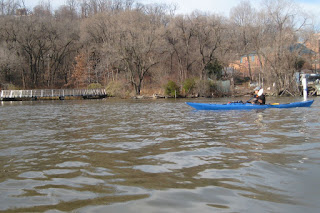
We decided to keep on, heading for the three bridges of Hamilton, Washington, and High Bridge. As we approached, the current abruptly changed, and we only made it to the first of these bridges before deciding to turn back.

Earlier, we realized we had not seen anyone else on the water - including motorized vessels. That changed as one of the Classic Harbor Line vessels (the Manhattan) approached and passed us by.

We paddled back and landed at the near near Peter Sharp, aka Swindler's Cove. We took an extended break, used the local facilities, took pictures, talked about things going on in the club. We watched the tide drain out, leaving our boats high and dry. We hoped in and paddled around, stopping in a nearby marsh area first.
I like to chase wildlife. Geese are pretty patient; Mallards will take flight at a greater distance. Whatever these birds were, they allowed me to tail them, riding in their wake.

Generally, conditions in both the Harlem and the Hudson were very calm. With slow current, the water became glass-like, lending itself to plenty of reflective images such as this.

As we went back, I snapped this shot of the Spuyten Duyvil railroad bridge. We watched it move from closed to open, to closed again, locking into place with a distinctive sound.

And that was our trip. The current had tuned while we were out, making for a much easier trip on the way back.
I'll write in more detail about the drysuit separately, but generally, it works really well - though I haven't put it through trials yet. I do tend to retain a lot of heat, and need to adjust my layering underneath, and I'm still perfecting my acrobatic routine for donning and exiting the suit. However, it isn't hard to paddle in, and I'm looking forward to more paddling further into the winter season.
Last weekend - the 8th - I went to the Inwood Canoe Club intending to work on a boat I've been repairing, and then to go for a paddle. As it happened, I ran in to one of the club officers, KM, who was heading out for a paddle. I reversed my plans, paddling with him before coming back to work on the boat.
The current was near max ebb as we headed north, making for a hard paddle up the river. Wind was coming from the west, so as we made the turn to go into Spuyten Duyvil, there were some squirrelly currents to deal with. Once we were in the Harlem River, however, both the wind and current died down a bit, and we had an easier time. We made it as far as the Broadway Bridge before turning around and heading back - much easier as drifted back with the current.
Yesterday, I went out with AA, another friend from the club. We timed our trip with the current, riding up the Hudson quickly and into the Harlem.
As we came up by Peter Sharp, we too in the coastline. Accustomed to spring and summer, the most noticeable difference is that with a lack of foliage, much more is visible.

Paddling Past the Park.
We decided to keep on, heading for the three bridges of Hamilton, Washington, and High Bridge. As we approached, the current abruptly changed, and we only made it to the first of these bridges before deciding to turn back.

The Hamilton, Washington, and High bridges.
Earlier, we realized we had not seen anyone else on the water - including motorized vessels. That changed as one of the Classic Harbor Line vessels (the Manhattan) approached and passed us by.

The commercial touring yacht Manhattan.
We paddled back and landed at the near near Peter Sharp, aka Swindler's Cove. We took an extended break, used the local facilities, took pictures, talked about things going on in the club. We watched the tide drain out, leaving our boats high and dry. We hoped in and paddled around, stopping in a nearby marsh area first.
I like to chase wildlife. Geese are pretty patient; Mallards will take flight at a greater distance. Whatever these birds were, they allowed me to tail them, riding in their wake.

Birds on the Water, Harlem River, New York.
Generally, conditions in both the Harlem and the Hudson were very calm. With slow current, the water became glass-like, lending itself to plenty of reflective images such as this.

Bronx Buildings Reflected
As we went back, I snapped this shot of the Spuyten Duyvil railroad bridge. We watched it move from closed to open, to closed again, locking into place with a distinctive sound.

And that was our trip. The current had tuned while we were out, making for a much easier trip on the way back.
I'll write in more detail about the drysuit separately, but generally, it works really well - though I haven't put it through trials yet. I do tend to retain a lot of heat, and need to adjust my layering underneath, and I'm still perfecting my acrobatic routine for donning and exiting the suit. However, it isn't hard to paddle in, and I'm looking forward to more paddling further into the winter season.
Subscribe to:
Posts (Atom)